Tuesday, August 30, 2005

Government MNAs accuse their own government of rigging elections!

We thought we had seen and heard it all, but this takes the cake.

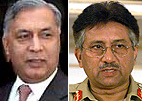
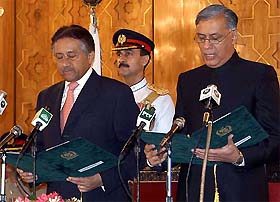
Don't worry soon it will all be brushed under the carpet so that we can 'officially' pretend as per Musharraf and Shaukat Aziz's words that the local government elections were 'free, fair and transparent'.

___________________________


Daily Times reports that in the National Assembly yesterday:

  • The prime minister expressed his satisfaction on the 'free, fair and transparent' local government elections. As he concluded his speech, several members stood up and rejected his claims.
  • Prime Minister Shaukat Aziz was cornered into an embarrassing situation on Monday after several treasury members of the National Assembly accused their own government of rigging the local council elections.
  • We are the victims of massive rigging. The entire nation is united against this rigging,” shouted treasury parliamentarian Riaz Hussain Pirzada on the floor of the National Assembly (NA).
  • Sources said Pirzada accused that the government machinery was used to ensure the victory of selected candidates. He said the party central and provincial leadership had given a cold response to his complaints. Chaudhry Shujaat Hussain, the PML president, tried to hush up the matter, but the annoyed MNAs said they would not stay quiet. They said that the PML's top leadership had its own interests in the matter.
  • Sher Akbar Khan, another treasury member, said he was the victim of pre-poll rigging by a minister of state. He did not name the minister, but sources said he was referring to Amir Muqam, the Minister of State for Water and Power.
  • Several treasury MNAs vented their feelings during the parliamentary party meeting of the ruling coalition before the NA session. They criticised the top PML leadership of protecting its own interests.
  • The MNAs demanded that the prime minister, who attended the meeting, explain his position and arrange their meeting with President General Pervez Musharraf to take up the issue of rigging.
  • Farooq Leghari said his candidates were opposed by the PML's top leadership in his constituency. According to PML sources, the Chaudhrys of Gujrat had backed Hassnain Dareshak's candidates against Leghari's son, Jamal Leghari, in Rajanpur district.
  • Khalid Lund, member of the Sherpao-led Pakistan People's Party (PPP), said his candidates lost the elections because Arbab Ghulam Rahim, the Sindh chief minister, rigged the elections.
  • Daniyal Aziz, the National Reconstruction Bureau (NRB) chairman, and Maj (r) Tanvir Hussain also made similar complaints.
  • Later, speaking on the NA floor Qazi Hussain Ahmed, the Muttahida Majlis-e-Amal (MMA) parliamentary leader, said the nation wanted the parliament to take action against the massive rigging.
  • The entire opposition also grilled the government of manipulating the elections to change results in the favour of its candidates. The opposition members raised slogans and staged a token walkout from the proceedings.

Monday, August 29, 2005

A Sublime Moment

By taking the world’s top two test sides, adding a venerated 123 year-old trophy, mixing passion, talent and determination in equal doses and then churning the potion well, a most remarkable sporting event has come to pass. This potent mixture has managed to produce the most dazzling cricketing series of modern times.

___________________________________________

And now to its 4th leg - Trent Bridge.

The English team made a brilliant 477 in their first innings. In reply the once mighty Australians crumbled to a score of 218 and were then forced to follow on (their first in 17 years). In their second attempt the Australians made a modest improvement by scoring 378 runs, but that left the English team a lowly target 129 runs for victory. Easy to achieve? Yes, or that is what everyone thought.

And then the magic began.

Shane Warne - his habitual yobbish behaviour suddenly a distant memory - produced what could be an all-time definitive performance of the art of spin bowling. From the other end an athletic Brett Lee hammered the ball with precision at speeds reaching 96 mph. English wickets began tumbling like skittles – 1/32, 2/36/ 3/57 and 4/57.

It must have been nerve-racking for the English and Australian spectators in the stadium and those glued to their television sets. However for cricket aficionados of other nationalities it was pure poetry – cricket at its most sublime. We were witnessing a moment to remember for years to come – spin bowling at its finest.

Thank you, Your Yobbishness, all is now forgiven and forgotten!


Sunday, August 28, 2005

Pakistan Election maxim: Make the Police get your Votes for you.


While there has been a shrill crescendo of accusations made by opposition politicians about rigging in the local government elections, alarm bells really start to clang when government allies like former president Farooq Ahmed Khan Leghari make similar charges .

While Farooq Leghari is a Musharraf-supporter and member of Muslim League (Chumcha Group), his son
Awais, Federal Information Technology Minister, has charged that “technical rigging” was resorted to for the success of the Dareshak group in the Rajanpur district of Punjab. According to him, police used the code name of “Baba Sain” for the victory for Dareshak’s panel. ‘Baba Sain’ is apparently one Nasrullah Dareshak, a loyalist of Chaudhries Pervez Ellahi and Shujaat Hussain.

Therefore the truism of the day belongs to one politician who fittingly said that he could could “defeat anybody anywhere if he were given the district police officer of his choice.”


__________________________________________

Interestingly the rifts created within the Pakistan Muslim League (Chumcha) leadership by these elections, only go to suggest that
the PML is nothing more than a group of individuals protecting their own political interests.


Friday, August 26, 2005

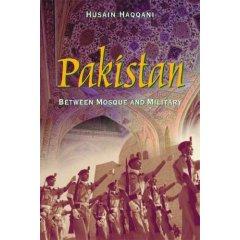
Haqqani - 'The Unholy Army Mullah Alliance'

Husain Haqqani has a flawed reputation in Pakistan, not only for his notoriously self-advancing political flip-flops, but also for his grubby repute as the originating godfather of corrupt - lifafa - journalism.

Nevertheless he has managed to write a fine study of Pakistan’s political history, with particular emphasis on the historically symbiotic relationship between the Islamic cleric and the army leadership.


There are one or two glitches in his reasoning but nothing profound. I, for one, don’t buy his theory that Bhutto possibly walked into ‘a trap’ as a result of a glowing ISI memo that suggested that he would ‘sweep the polls’ in 1977.

Rather than write a lengthy review of Pakistan: Between Mosque And Military , here is a pertinent excerpt from one already published in the Wall Street Journal:

After each of Pakistan's many coups, Mr. Haqqani shows, the Pakistani military has "adopted Islamic ideology" to fashion itself as the guardian of the nation and its core beliefs. In doing so it has repeatedly co-opted Islamist organizations--notably the Jamaat-e-Islami--for cover and support. The military has also followed a policy of divide and rule, patronizing existing Islamist groups while seeding new ones that might rival them.
Mr. Haqqani marshals a wealth of evidence to document such claims. He describes in detail the mosque-military alliance during Pakistan's first two military regimes--that of Field Marshall Ayub Khan (1958-69) and Gen. Yahya Khan (1969-71), both generally regarded as secular, whiskey-swilling good old boys. He thus shows that Pakistan's creeping Islamization predates the rule of Gen. Zia ul-Haq (1977-88), the man widely held responsible for giving Islam a major role in all aspects of Pakistani life. Gen. Zia, it turns out, only tightened an alliance that already existed.
Mr. Haqqani argues that, over the past two decades, Pakistan's army has fueled the passions of some of the country's most extreme radicals. Bankrolling these groups has served the strategic purpose of rendering the military desirable by contrast. International observers--not least the U.S. State Department--thus conclude that the military is necessary for Pakistan's stability. The shadowy Inter-Services Intelligence agency (ISI) has played an especially critical role in this game.
As a 1990 ISI report on the future of U.S.-Pakistan relations concluded: "It was important to maintain the impression of widespread anti-U.S. sentiment in Pakistani society, which could be assured by periodic demonstrations by Islamists. This would create sympathy for Pakistani military and intelligence officials among their US counterparts." Flash forward to 2005: Gen Musharraf's regime bans the protest rallies of journalists, feminists and members of the Pakistan People's Party, headed by former prime minister Benazir Bhutto. Meanwhile, Islamists manage to hold anti-American "million man marches" throughout the country. How little times have changed.

.... What Mr. Haqqani shows is that a Manichean dichotomy--army good, Islamists bad--obscures the partnership between the two. A better way of combating Islamic radicalism, Mr. Haqqani argues, is to strengthen the very democratic forces that the military abhors.


Thursday, August 25, 2005

Messrs.Dr. No and Dr. Khan & The little matter of North Korea

In an interview Tuesday with Kyodo News Musharraf was quoted as admitting the following facts:

- 'Yes, [A. Q. Qadeer Khan] passed centrifuges -- parts and complete. I do not exactly remember the number,' Musharraf was quoted as saying when asked to comment on reports that Islamabad told Tokyo that Khan gave about 20 centrifuges to North Korea.

- Musharraf said Khan's help would not have been decisive to North Korea's efforts to become a nuclear power because he was not involved in other crucial areas of technology, such as a trigger system. 'So if North Korea has made a bomb... Dr. A.Q. Khan's part is only enriching the uranium to weapons grade,' Musharraf told Kyodo. He does not know about making the bomb, he does not know about the trigger mechanism, he does not know about the delivery system.' _______________________________________________________________

By his admission Musharraf has apparently opened up a new minefield for himself . Questions are now being raised demanding more answers.


As
New York Times asks today:

Pakistani and American experts have said it is plausible that Dr. Khan smuggled nuclear bomb designs and other small items out of Pakistan. But they said it would be virtually impossible for him to have removed large centrifuge machines from the country's nuclear labs and ship them out of the country without the military knowing.

"I think it would be absolutely shocking that they not have some idea," said George Perkovich, a nonproliferation expert at the Carnegie Endowment for International Peace in Washington. "There were planes flying back and forth."

_________________________________________________________________

Well OK then, say if our heroic AQ Khan had the resources that were available to Dr No, such as:

  • A private island
  • Several dozens of (preferably armed) employees
  • A fleet of heavy load carrying trucks
  • One or two cargo carrying C-130 airplanes
  • A private airfield
  • An equivalent of Ursula Andress (then maybe not, as James Bond has yet to make his appearance)

Well then, AQ Khan could easily have packed off the centrifuges and more from Kahuta all the way to to North Korea or for that matter Nebraska, USA.

_________________________________________________________________


But if he didn’t have Dr No’s resources …umm…then try and imagine the following telephonic scenario:

"Hello, is that PIA Cargo? This is the Great Khan here."

"Really is that Imran Khan?"

"No you moron, not Imran. This is the Great ‘Atum Bum’ Khan!"

Sound of a crash/thump then a barely audible voice comes on: "Very sorry, Sir. It's just that my legs suddenly gave way."

"Boy, get off your knees now and listen to me carefully.
I need to send 20 tonnes of cargo to Pyongyang, North Korea."

"Deeply sorry, Sir. Our planes don't fly to North Korea."

"You don’t fly to North Korea? Well take it from me, as of now your airline does. Got that?"

"Yes, Sir, I understand you. Could you please tell me sort of cargo you are planning to send to North Korea?"

"What kind of cargo? Well it is top secret stuff from Kahuta so mind your own business. Any way all I can tell it is very heavy sort of stuff that needs to be picked up from here."

"We've got no trucks, Sir. Is there some way that you can arrange delivery to the airport?"

"What do you mean you can’t accept delivery from Kahuta because you've no trucks? You better buy the bloody trucks and pronto!"

Understood, Sir. Please tell me how can we arrange to get our newly bought trucks get into the high security at Kahuta?"

"Don't worry, I'll provide the truck drivers with the secret password that will let them through the security ring of missile batteries, ack-ack guns, armoured vehicles and heavily armed commandos."

(and so on and so forth)

Daddy, Could you buy me a Porsche?


According to recent reports over one-third of the population of Pakistan is inadequately fed, clothed and housed. Worse still poverty – especially in the rural areas – is believed to be increasing rather than decreasing.

So using desi logic it comes as no surprise to learn that that the
German luxury sports car maker Porsche has announced that it will start selling cars in Pakistan in 2006.

It makes abundant sense that some spolit prat - son of some extremely corrupt businessman / bureaucrat / feudal / military officer - should drive around on our potholed streets flashing his father’s ill-gained wealth.

Nothing could be more in tune with the values of Pakistan's moneyed elite.


Wednesday, August 24, 2005

Send this Criminal Nutcase to Guantanamo

While Pakistan has its fair share of religious nutcases, it is by no means the only country to be so richly endowed. These days our ‘fundos’ cautiously watch over their shoulders before they utter their bilious inanities; the same however does not apply to their counterparts in America.

Yesterday the US religious broadcaster Pat Robertson publicly called for assassination of Venezuelan President Hugo Chavez.

According to
BBC he said:

We have the ability to take him out, and I think the time has come that we exercise that ability."
"We don't need another $200bn war to get rid of one, you know, strong-arm dictator.
It's a whole lot easier to have some of the covert operatives do the job and then get it over with."

While President Chavez wisely declined to comment his deputy said Mr Robertson had made "terrorist" remarks and the country was studying its legal options.

Your blogger suggests that the US government should immediately send this religious extremist to Guantanamo Bay.


Monday, August 22, 2005

'Not Irani Uranium but Pakistani' - IAEA


All the hullabaloo over Iran’s producing weapon grade uranium has come to naught.

Recently Bush and his men have screamed themselves hoarse over the looming Iranian atomic peril, but latest scientific findings have determined that the weapons-grade traces of uranium discovered in Iran were of Pakistan origin. It is believed that this trace element came from contaminated Pakistani centrifuges which had been previously smuggled in to Iran.

Today’s
Washington Post has the story:
Traces of bomb-grade uranium found two years ago in Iran came from contaminated Pakistani equipment and are not evidence of a clandestine nuclear weapons program, a group of U.S. government experts and other international scientists has determined.
"The biggest smoking gun that everyone was waving is now eliminated with these conclusions," said a senior official who discussed the still-confidential findings on the condition of anonymity.

Scientists from the United States, France, Japan, Britain and Russia met in secret during the past nine months to pore over data collected by inspectors from the International Atomic Energy Agency, according to U.S. and foreign officials. Recently, the group, whose existence had not been previously reported, definitively matched samples of the highly enriched uranium -- a key ingredient for a nuclear weapon -- with centrifuge equipment turned over by the government of Pakistan.

Iran has long contended that the uranium traces were the result of contaminated equipment bought years ago from Pakistan. But the Bush administration had pointed to the material as evidence that Iran was making bomb-grade ingredients.

The conclusions will be shared with IAEA board members in a report due out the first week in September, according to U.S. and European officials who agreed to discuss details of the investigation on the condition of anonymity. The report "will say the contamination issue is resolved," a Western diplomat said.

U.S. officials have privately acknowledged for months that they were losing confidence that the uranium traces would turn out to be evidence of a nuclear weapons program. A recent U.S. intelligence estimate found that Iran is further away from making bomb-grade uranium than was previously thought, according to U.S. officials.

Saturday, August 20, 2005

Rigging to Elect Servile Dummies


As many had predicted (including your blogger) the local government elections held on 18th August proved to be a complete and utter farce.

Remember Musharraf’s referendum or Shaukat Aziz’s by-elections in Attock and Tharparkar? Well those were simply minor dress rehearsals for this main event.

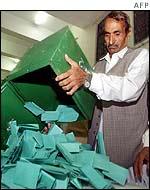
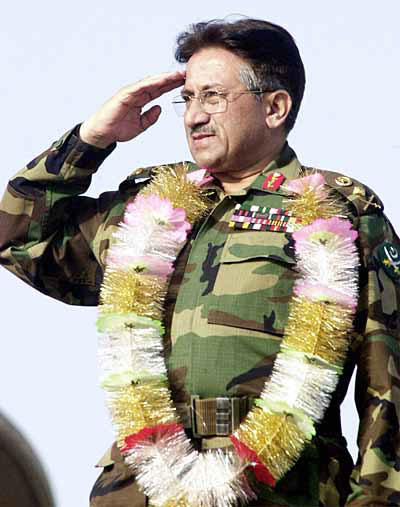
On Thursday the ballot boxes were stuffed to the gills to ensure victory to the usual crop of incompetent but usefully servile office bearers (one of them is posing in the photo above left - as you can see these people will do anything to satisfy their political masters!).


The policemen were of course deputed in their thousands to make sure no one dare interfere in these officially organised proceedings.

Here is what Islamabad-based diplomats told London’s
Financial Times:

Voter turnout has been falling in Pakistan because of widespread pre-poll rigging and this election, which has been relatively calm, is expected to follow the pattern. “People are getting less interested because they know votes are rigged,” said another western diplomat. “In the 1970s the turnout would be 50-60 per cent. Now it's in the low 40s.”


Here is what an irate columnist said in today’s edition of the Daily Times

  • The upcoming polls appear to be a repeat performance of the by-election fought by Shaukat Aziz in Attock.
  • General Musharraf is a “brave” man like all those who seize power. He does not care about what people think of us in the world so long as the US administration does not cry “foul”. The local opposition is too weak to do anything.
  • The post of the nazim suddenly has lost favour with the regime. He has been made an NCO under the chief minister, thanks to the indiscriminate amendments that have been made to the original order. This proves that civilian institutions, like the constitution, are a hoax.
  • The DPO [previously known as a District's Superintendent of Police] has also been made directly subservient to the chief minister. Some opposition leader said the other day that only rigging was “transparent” all over the country.
  • The local elections will only bring in a crop of servile office-bearers. It appears to be a dress rehearsal for the drama that will be unleashed on the people of Pakistan in 2007, as the general would like to continue in power with the help of his hangers-on in defiance of the constitution.
  • The CEC’s office remains stigmatised due to its infamous history. Expecting it to conduct fair elections is akin to asking for the moon. There is nothing much that a “civil servant”, however well-meaning, can do except resign. However, Pakistan is not known for such principled conduct.
  • So the CEC is selectively using “sound and fury” against the opposition mullahs while the Q-league chief ministers in Punjab and Sindh disregard the election law/rules as their master disregards the constitution of Pakistan which has no defender except the silent majority or a muzzled opposition.
  • Given our sordid history, we may have to outsource the elections if we want to ensure that they are fair and free.


Thursday, August 18, 2005

Testing the waters for 2007?


Many political commentators believe that today’s local government elections are a dress rehearsal for the 2007 general elections.

Why so? The answer is that those elected into the powerful positions of district nazims will be able to greatly influence the results of the 2007 elections.

A district may produce a number of MNAs and MPAs, but most of the tools of political patronage (such as development funds and schemes, job appointments and postings) will be routed through the nazim, hence the office holders utility to the Establishment.

In Punjab every attempt will be made to sideline the PPP and PML (Nawaz) leaving the field open for the Establishment’s Pakistan Muslim League (chumcha fasction), known as the PML (Q).

In Sindh Musharraf’s chief minister Arbab Rahim is coercively bulldozing his way to ensure that rural Sindh elects the ‘right’ candidates, which of course means non-PPP.

In the urban areas the Muttahida Majlis-e-Amal MMA has been dumped in favour of the MQM.

In Balochistan and NWFP the military regime will do its best to undermine the MMA’s electoral support.

The unwritten alliance between the religious parties and the military government - which allowed the two to coexist despite differing views – is all but dead (read interesting
BBC article on this). Some believe that these religious parties will soon find themselves in the political wilderness again (until, of course, the day they prove to be of use to the military again).

If the results of the local government election prove favourable to Musharraf then his confidence is bound to regain itself. He might even ride roughshod over his critics by dismissing the assemblies months before the 2007 elections and instead opt to rule via the ‘democracy’ of local governments.

On the other hand a poor showing of PML(Q) will force Musharraf to re-evaluate his strategy.

musharraf
pakistan

Sunday, August 14, 2005

Musharraf: Past His Sell-By Date? (Part II)


In Part II we carry on with jogging your memories with the remainder of the seven promises the General made to his countrymen. Let’s consider what became of them.


4 • Ensuring law and order, and dispensing speedy justice

- While there was much talk of reforming the police little has been done. Instead virtual autonomy has been handed over to the police force without establishing the necessary safeguard of local public safety commissions keeping an eye on their activities.
- In Punjab and Sindh government politicians still rely on the police to harass and brutalize their political opponents in an attempt to subjugate them by registering false criminal cases against them.
- International institutions maintain that Pakistani police continues “to routinely engage in crime; use excessive force in ordinary situations; arbitrarily arrest and detain citizens; extort money from prisoners and their families; accept money to register cases on false charges; rape female detainees and prisoners; commit extrajudicial killings; and torture detainees, often to extract confessions. Political opponents, former government officials, and other critics of the regime are particularly at risk of arbitrary arrest or abduction, torture, and denial of basic due process rights at the hands of military authorities”.
- Obviously an obedient police force is more important to the Musharraf regime than one that is competent and ensures a decent state of law and order.
5 • Depoliticizing state institutions

- Suffice to say both that the senior judiciary and bureaucracy (particularly the police) continue to remain an adjunct of the military regime.
- At the same time the powerful institution of the Pakistan army remains as politicized as ever.
6 • Devolving power to the grassroots level

- The manner in which provincial and district administrations are coercively creating ‘unopposed candidates’ in the current local government elections renders the whole elective process meaningless as far as the ‘grassroots’ or any other level is concerned.
- All I need do here is quote Professor Stephen Cohen, the Brookings Institute authority on Pakistan, who maintains that the local government scheme was ‘deliberately sought to further weaken provincial power’.
- Cohen further suggests (and I can’t disagree with him) that ‘perhaps the real purpose of the exercise is to curry political favour by creating a class of notables who owe their position to Army Headquarters’. He adds that corrupt Nazims are openly tolerated providing they toe the line dictated by the local military commander. It is hard to disagree with this analysis.

7 • Ensuring swift and across-the-board accountability

- As we all know NAB’s process of accountability has been brazenly manipulated in pursuit of a political agenda. Cases against Interior Minister Aftab Sherpao, Kashmir Affairs Minister Faisal Saleh Hayat, Industries Minister Jehangir Tareen, Water and Power Minister Liaquat Jatoi and several others were put on ice or withdrawn once they pledged their loyalties to Musharraf.
- Others such as the notoriously rapacious Chaudhries from Gujrat, the billionaire ex-bureaucrat Imtiaz Shaikh from Sindh and others tainted with acts of high corruption were deliberately disregarded by NAB.
- Members of the judiciary and the Pakistan army have also been intentionally exempted from any form of accountability.

Having largely reneged on his 7-point commitment that he voluntarily made to the nation, General Musharraf ought to be reminded of his dig at his predecessors’ ‘sham democracy’. OK, if Nawaz Sharif and Benazir Bhutto ruled under the cover of ‘a sham democracy’, what has Musharraf given us after nearly six years of complete power?

These days we have a hapless ‘Prime Minister’ who was taken more seriously as a Minister of Finance. Shaukat Aziz has not only been ordered to keep his hands of Punjab but has also been known to privately admit that he lacked authority even to transfer a deputy secretary.

And now we have an almost completely pre-rigged local government election. By the time foreign observers arrive to monitor the ballot the result will have already been predetermined.

So are we being ruled with ‘supreme national interest’ or ‘Pakistan first’ in mind? (Now kindly refrain from laughing out too loud).

As fifty years of Pakistan's history would suggest: it's all about the kursi of course.


Saturday, August 13, 2005

Musharraf: Past His Sell-By Date? (Part I)

Late night on 12 October 1999 millions of Pakistanis - disgruntled by Nawaz Sharif’s despotic kleptocracy - watched with rising hopes as a palpably nervous General Musharraf appeared on television vowing to change the dismal prospect that faced the country and its hundred and sixty million citizens.

A few days later he appeared once more on television solemnly promising a period of sound governance based upon a seven-point commitment he then made to the nation.

To jog your memories here are the seven promises the General made to his countrymen. It is time to consider what became of them.

Pledge No. 1 • Rebuilding national confidence and morale

- It would perhaps be stating the obvious to suggest that Musharraf has acted on nationally vital issues only when prodded into action by Washington.
- The Pakistan government has never been so visibly externally influenced as under Musharraf’s reign. And so, in my view, with such loss of national sovereignty, any talk about ‘national confidence and morale’ becomes largely redundant.
- Further, the farce of the referendum endorsing Musharraf as ‘president’ and the manner in which prime ministers are dismissed and appointed (not forgetting Shaukat Aziz’s brazenly rigged elections in Attock and Tharparkar) has helped erode what little confidence that people may have placed in the current system of governance.

Pledge No. 2 • Strengthening the federation, removing inter-provincial disharmony and restoring national cohesion
- Consider Balochistan - Dera Bugti, Sui, Gwadar and the reported activities of the Balochistan Liberation Army in particular.
- Consider Sindh - Kalabagh Dam, the National Finance Commission (NFC) fiasco and the blatantly political gerrymandering of districts and constituencies.
- Consider NWFP - MMA government, Hasba Bill, Wana, Chief Minister Durrani’s disputes with the. National Security Council and NWFP’s Musharraf-appointed governor.
If anything, mistrust of the ‘majority province’ has more likely increased rather than abated during Musharraf’s time in power.

Pledge No. 3 • Reviving economy and restoring investor's confidence
- Admittedly the economy is in much better shape, but harsh reality indicates that it was only the rich who got richer , mostly through property and share market speculations.
- The World Bank and other international institutions are bemoaning the sharply increasing poverty levels among 60% of the population – the rural Pakistanis.
- What about the widespread rumors of members of the cabinet engaged in insider trading at the stock market and making their billions?
- And what about the plethora of land scams – from Gwadar to the ever burgeoning Defence, Behria and private housing schemes.


Thursday, August 11, 2005

Spilling Extremely Explosive Beans


Grumpy with the Musharraf regime, religious supremo and parliamentary leader of the opposition Maulana Fazlur Rehman has lashed out by accusing the regime of covertly assisting militants enter Afghanistan through Waziristan.

According to the
Daily Times Fazlur Rehman recently stated the following:

The Pakistani government is deceiving the US and the West by helping militants freely enter Afghanistan from Waziristan

The government should give the identity of the infiltrators and its (government’s) motives for helping them enter Afghanistan. “They must also give the nation the identities of the men being moved from Waziristan to militant camps in Mansehra. This is hypocrisy. The rulers are not only trying to deceive the US and the West, but also hoodwinking the entire nation,” he added.

“We ask the rulers to reveal the identity of the people being transported to Afghanistan from Waziristan via Kaali Sarak in private vehicles, reveal who is supervising their trouble-free entry into Afghanistan and reasons for their infiltration,” he said.

The government would have to decide whether it wanted to support jihadis or close down their camps, he said, adding, “We will have to openly tell the world whether we want to support jihadis or crack down on them. We can’t afford to be hypocritical anymore,” he said.
If pressured he would reveal facts that would open a Pandora’s box.

I doubt if we will get much more out of the old Maulana. These disclosures are the proverbial gunshot across the bow – in other words he is saying to Musharraf “lay off or I will reveal all”. Undoubtedly not wishing to be further exposed the regime will beat a quick retreat.

One can only begin to guess at the secrets that remain hidden from the public eye. But the damage has been done as these allegations are extremely explosive and ought to cause serious discomfiture to the regime.


Wednesday, August 10, 2005

Poor, Poor Shazia Khalid


Poor Dr. Shazia Khalid. Her woes continue. She and her husband, who gave up his engineering job in Libya to take care of her, are now living in a one-room dive in a bad neighborhood in London. They applied for asylum in Canada, where she has relatives and friends, but a Canadian bureaucrat rejected the asylum application on the ground that they were now safe in Britain.

A week ago New York Time’s columnist, Nicholas Kristof, published two articles on her plight:
‘Another Face of Terror’ (NYT, July 31, 2005) and ‘A Pakistani Rape, and a Pakistani Love Story’ (NYT, August 2, 2005).

In these articles Shazia Khalid reveals the following details about her brutal rape and the events that followed:

- The [rapist] spent the night in her room, beating her, casually watching television, raping her again and boasting about his powerful connections.
- Officials of Pakistan Petroleum rushed over and took decisive action.” They told me to be quiet and not to tell anybody because it would ruin my reputation," Dr. Shazia remembers. One official warned that if she reported the crime, she could be arrested.
- Dr. Shazia wasn't sure she dared to report the crime, but she begged for permission to contact her family. So, she says, officials drugged her into a stupor and then confined her in a psychiatric hospital in Karachi. "They wanted to declare me crazy," Dr. Shazia said bitterly. "That's why they shifted me to a hospital for crazy people."

-Dr. Shazia's husband, Khalid Aman, was working as an engineer in Libya, but he finally was notified and rushed back 11 days later. Dr. Shazia, by then freed, couldn't face him, but he comforted her, told her that she had done nothing wrong, and insisted that they report the rape to the police so that the criminal could be caught. That was, perhaps, naïve, particularly because there were rumors that the police had identified the rapist as a senior army officer and were covering up for him.

- [The] authorities locked up Dr. Shazia and her husband, Khalid Aman, keeping them under house arrest for two months. Then officials began to hint that Dr. Shazia was a loose woman, perhaps even a prostitute - presumably as a way to pressure her and her husband to keep quiet. Dr. Shazia, mortified, tried to kill herself. Mr. Khalid and their adopted son, Adnan, stopped her.

- General Musharraf was finding this couple's determination to get justice increasingly irritating. So, Dr. Shazia and Mr. Khalid said, the authorities ordered them to leave the country, and warned that if they stayed, they would be killed - by government "agencies" and that no one would even find their bodies.

- When Dr. Shazia demanded that Adnan be allowed to accompany her, the officials warned that there was no time and that she would be murdered if she delayed. Then the officials forced Dr. Shazia to make a video recording in which she thanked the government for helping her. And, she said, they warned her that if she had any contact with journalists or human rights groups, they would strike back at her - or at her relatives still in Pakistan. "They said, 'We know where your family is here,' " Dr. Shazia recalled. "I'm very scared and concerned about my family and their safety. But I believe we must tell the truth, and I have entrusted my family to God." So the Pakistani officials put Dr. Shazia and Mr. Khalid on a plane to London, without their son.

Since publishing his articles Nicholas Kristof has commenced upon a campaign to make the Canadian government allow the Khalids to live in Canada. According to a leading
Canadian newspaper:

In a note on the Times on-line version of the article, Mr. Kristof urges readers to contact Immigration Minister Joe Volpe and put pressure on him to admit the Khalids.
"Since they are lonely and isolated in London but have friends and relatives in Canada, the single thing that would help the most is if Canada reconsidered its refusal to grant them asylum."


Tuesday, August 09, 2005

The Farce Continues


The local government elections have become nonsensical to say the least.

In rural Sindh chief minister Arbab Rahim is using naked coercion to force PPP-supported candidates to ‘withdraw’ from the elections. In his native Tharparkar district recent reports (BBC Urdu World Service) indicated that 38 out of 40 union council nazim candidates have already emerged as ‘unopposed’. Other rural districts in Sindh reveal the same dynamics albeit at a lesser scale. In Kashmor district, for example, a simple majority of union council candidates have already been registered as ‘unopposed’ thereby ensuring that the Islamabad approved district nazim is elected.

In Karachi and Hyderabad a extremely violent struggle is taking place between MQM and MMA – many have died and many more will by the time polling takes place. Musharraf provided impetus to MQM with his television announcement asking the public not to vote for religious parties. It is obvious that Islamabad supports MQM, which is a pity for many Karachi-ites as Naimutullah Khan has proven to the best mayor the city has had in fifty years.

In most areas of Punjab PPP and PML-Nawaz have been ‘left out’ as Muslim League (Chumcha Group) members battle it out among themselves. Invariably one group in each district is supported by the ruling provincial government of the Gujrat Chaudhries and its opponent consists of an amalgam of Muslim Leaguers opposed to the Chaudhry hegemony over Punjab. Contrary to Election Commission imposed rules a large number of district administrations have been changed in the past few weeks by chief minister Pervez Ellahi to ensure that his loyalists remain in power.


All that the beleaguered candidates and political groupings from Sindh and elsewhere can do is appeal to the Chief Election Commissioner, Justice Abdul Hameed Dogar. Thousands of faxes have already been sent to Justice Dogar, but what can the helpless man do but issue press statements warning people to obey his directives or else he will be forced to issue further, even more vociferous, press statements.
____________________________________________________________

Professor Stephen Cohen, the Brookings Institute expert on South Asia and Pakistan, states that Musharraf’s local government scheme was ‘deliberately sought to further weaken provincial power’ and adds that ‘perhaps the real purpose of the exercise is to curry political favour by creating a class of notables who owe their position to Army Headquarters’. According to Cohen, corrupt Nazims are openly tolerated providing they toe the line dictated by the local military commander.

In other words only Rawalpindi rules!


Monday, August 08, 2005

Sunday, July 24, 2005

Shaukat Aziz Takes On Mush!


A year ago the Commando-in-Chief was disgruntled by his prime minister who was known for his abject servility. So he chose a new candidate, possibly the richest man in Pakistan due to the legacy received from his late father, a corrupt general from Zia’s days. But the Choudhries of Gujrat went in to rebellion as this son-of-a-general was a Punjabi and therefore presented a potential threat to their power grip on the province. So a compromise candidate was brought into the picture – none other than our $70 million ex-banker from New York. Why him? Because lacking any following he could not politically threaten anyone. Or that is what everyone thought.

So in August last year Shaukat Aziz became prime minister after two blatantly rigged elections in the Attock and Mirpurkhas constituencies.

A year later the worm has apparently turned. Probably fed up with being laughed at by other politicians and not being taken seriously by the public at large, he has decided to take himself more seriously. After all powerless though he was, he is the prime minister. And this office inherently attracts its own set of power groupies who most likely would urge him on. I would imagine they told him that ‘real power’ resides in Washington and it was time he made his move.


And now, not surprisingly, a power tussle has emerged. Recent reports indicate that it is now coming to a head as Shaukat Aziz has instructed heads of all law enforcement agencies to report to him directly. Last week an operation was led on Musharraf’s instructions on a number of madrassahs. It is believed that Shaukat Aziz suspended and transferred a number of the police officials involved in the madrassah raids

Also, it was apparently Shaukat Aziz who decided to cancel his visit to Washington. It is said he did not particularly like to play a junior third fiddle shortly after the Indian Manmohan Singh’s much trumpeted visit to the USA. Opponents say his newly inflated ego could not bear the perceived humiliation. His cancellation is said to have caught both Washington and Musharraf by surprise.

Not surprisingly a replacement PM is on the way. An MNA seat in northern Sindh has already been earmarked for Muhammad Mian Soomro. After the local bodies elections the vacant MNA seat will be ‘won’ by Soomro in a bye-election. And, if the agencies have their way, we will have another prime minister in Islamabad.

How long Soomro will stay docile is anyone’s guess.

You heard the news on this blog first.

Thursday, July 21, 2005

Misfits of Inglistan (Part III)


In the late 1980s I read 22 year-old William Dalrymple’s book ‘In Xanadu: A Quest’, a story of his memorable journey across Asia to the ruins of Coleridge’s ‘stately pleasure dome’ in Xanadu (modern day Duolon for pedantics). Over the years I managed to keep up with some of Dalrymple’s writings, such as ‘City of Djinns’ and ‘The Age of Kali’, but I must confess that even though I bought a copy of his ‘White Mughals’ two years ago, it remains in a pile of books still waiting to be read. But read they shall be.

On a philosophical level I maintain that quality writers know more about the ‘state of human condition’ than self-proclaimed experts of society such as politicians, historians, economists, journalists and sociologists. The reality of 19th century London or Russia, I believe, is better captured by reading the likes of Dickens and Tolstoy than by dredging through dreary statistics or dense historical tomes. Similarly truthful authenticity of 20th century Columbia and Egypt are better revealed by Gabriel Garcia Marquez and Naguib Mahfouz than by trolling through a host of non-fiction works.

Having said all this, I come back to William Dalrymple, who has spent his investigative years in both the East and the West. To me he has a better understanding of social realities than a truck full of professional newspaper columnists.

Here then is an excerpt of an erudite article he recently wrote for The Guardian

But it is now becoming very clear that producing cannon-fodder for the Taliban and graduating local sectarian thugs is not at all the same as producing the kind of technically literate al-Qaida terrorist who carried out the horrifyingly sophisticated attacks on the World Trade Centre. Indeed, there is an important and fundamental distinction to be made between most madrasa graduates - who tend to be pious villagers from impoverished economic backgrounds, possessing little technical sophistication - and the sort of middle-class, politically literate, global Salafi jihadis who plan al-Qaida operations around the world. Most of these turn out to have secular scientific or technical backgrounds and very few actually turn out to be
madrasa graduates.


The men who planned and carried out the Islamist attacks on America were confused, but highly educated, middle-class professionals. Mohammed Atta was a town planning expert; Ayman al-Zawahiri, Bin Laden's chief of staff, is a paediatric surgeon; Omar Sheikh, the kidnapper of Daniel Pearl, is the product of the same British public school that produced the film-maker Peter Greenaway.

Peter Bergen of Johns Hopkins University recently published the conclusions of his in-depth study of 75 Islamist terrorists who had carried out four major anti-western attacks. According to Bergen, "53% of the terrorists had either attended college or had received a college degree. As a point of reference, only 52% of Americans have been to college." Against this background, the backgrounds of the British bombers should not come as a surprise. The French authority on Islamists, Gilles Kepel, has arrived at a similar conclusion. The new breed of global jihadis, he writes, are not the urban poor of the third world - as Tony Blair still claims - so much as "the privileged children of an unlikely marriage between Wahhabism and Silicon Valley". Islamic terrorism, like its Christian predecessor, remains a largely bourgeois endeavour.

It is true that there are exceptions to this thesis. There are several examples of radical madrasa graduates who have become involved with al-Qaida. Maulana Masood Azhar, for example, leader of the banned Islamist group Jaish-e-Muhammad, originally studied in the ultra-militant Binori Town madrasa in Karachi.

By and large, however, madrasa students simply do not have the technical expertise or conceptual imagination necessary to carry out the sort of attacks we have seen al-Qaida pull off in the past few years. Their focus, in other words, is not on opposing the west - the central concern of the Salafi
jihadis - so much as fostering what they see as proper Islamic behaviour at home.

All this highlights how depressingly unsophisticated the debate about the British bombers is in this country. Again and again we are told that terrorism is associated with poverty and the basic, Qur'anic education provided by madrasas. We are told that the men who carry out this work are evil madmen with whom no debate is possible and who, according to Frank Field on last week's Question Time, "aim to wipe us out". All links with Iraq and Afghanistan are vehemently denied.

In actual fact, al-Qaida operatives tend to be highly educated and their aims clearly and explicitly political. Bin Laden, in his numerous communiques, has always been completely clear about this. In his first public statement, "A declaration of war against the Americans", issued in 1996, he announced he was fighting US foreign policy in the Middle East and, in particular, American support for the House of Saud and the state of Israel. His aim, he stated, is to unleash a clash of civilisations between Islam and the "Zionist crusaders" of the west, and so provoke an American backlash strong enough to radicalise the Muslim world and topple pro-western governments.

Bush has fulfilled Bin Laden's every hope. Through the invasion of secular Ba'athist Iraq, the abuses in Abu Ghraib, the mass murders in Falluja, America - with Britain's obedient assistance - has turned Iraq into a jihadist playground while alienating all moderate Muslim opinion in the Islamic heartlands and, crucially, in the west. Of course, we must condemn the horrific atrocities these men cause; but condemnation is not enough. Unless we attempt to understand the jihadis, read their statements and honestly analyse what has led these men to blow themselves up, we can never defeat them or even begin to drain the swamp of the grievances in which they continue to flourish.


Monday, July 18, 2005

Misfits of Inglistan (Part II)


One of the solutions must surely lie in communal integration.
______________________


One city, two worlds (Associated Press)
Muslims in Leeds don't integrate into English society

16 June 2005

LEEDS, England (AP) -- Young men wear tight jeans and T-shirts, their black hair gelled. The heavy and distinct Yorkshire accent — gruff with flat vowels — may be just as deceiving. Despite their outward Western appearance, the second and third generation Muslim Asian community in this northern town has barely integrated into British society — although many have never visited their ancestral homes of Pakistan, Bangladesh or Kashmir either.

The working-class neighborhood of Beeston, which came to world attention after at least two of its sons were involved in the July 7 suicide bombings in London, is one of many districts here where Asians from the Indian subcontinent have settled in the past 40 years.

While young men have largely chosen Western attire over traditional clothes, most young women prefer to wear shalwar kameez — loose trousers and a tunic — and hide their hair under loose thin scarves. But it’s not only the clothing, the complexion or the food, language or even religion that separates Beeston’s Muslim Asian community from its English and black counterparts. It is their distinct Islamic values and shared homeland ties that they cherish so much and fear losing.

Lahore in Leeds
Walking in their section of the neighborhood — the typical English red-brick row houses notwithstanding — feels like being in Lahore or any other town in Pakistan. In fact, the Asians here may even be more attached to their Pakistani values than many back in their ancestral towns. In a way, time seems to have stopped.

Elders — many of whom do not speak English well even though they have lived here for decades — maintain their strict customs. Perhaps more so as they regard the society here as alien, immoral and corrupting for their children.
They rarely mix with the English, even with next-door neighbors. Each sit on their porches, hardly communicating with one another, according to residents.

“My parents forbade me to speak English at home,” Tanver Akhtar, who was born here 33 years ago, said in her strong Yorkshire accent. Her parents still have difficulty speaking the language of their adopted country.

A life apart
Akhtar wears a shalwar kameez because “I want to be like others. I feel more respected by my community.” When she finished high school, her parents told her she could not go to university. “They thought I might get off track,” she said. Because she was brought up to obey her parents, she consented.

And now, she says, she is expected to obey her husband, whom she married out of love after struggling for years to get her parents’ approval. They had wanted her to marry a cousin, a tradition in her community.

Akhtar said she feels half British and half Pakistani. Then adds: “My parents were very strict, so I guess I feel more Pakistani.” She was not allowed to go out very much on her own, socialize like her English classmates or neighbors. She was to pray five times a day and cover her hair.

She speaks Urdu to her neighbors, to the local butcher and grocer, and even to her 4-year-old daughter, Suman. She said she would certainly allow her daughter to go to university, but not to date boys or marry an English man. “It’s totally wrong because he won’t be a Muslim,” she said.

No English friends
Like Akhtar, 22-year-old Amer, who did not want to give his last name because he wanted to avoid the public spotlight, was born here and has no English friends.

As a second year computer science student at a technical college in Leeds with a part-time job, Amer has very little time to socialize. But the few hours he’s free, he chats with his Pakistani friends on the Internet, or plays cards with them at home or cricket at a park. “We keep ourselves busy,” he said.

He said he does not drink alcohol because it’s forbidden in his religion. Nor does he go to the disco. “We’re not used to doing these things,” he says. “First of all, for religious reasons. If you go to a pub or disco, it’s mostly to look for girls. If I do that, then my sister would want to go to disco too.

Protecting honor of women
“Obviously, we don’t want our sister to be half naked in a disco,” said Amer, the youngest of three brothers and a 22-year-old sister. Such sentiment — about protecting the honor of sisters and female relatives — was widely expressed among Asian youths in Beeston. But not all of the community’s youths stay on track.

It’s not uncommon to see youths — who look more like thugs — roaming the garbage-strewn streets of Beeston. Drugs are consumed in the open. Many utter foul language and are hostile to outsiders. But this isn’t unique to the South Asian youths. English residents and others have complained about English thugs making trouble more than other ethnic groups.

Disaffected youths
Zack Hanif, 32, says there’s very little the young can do in Beeston, where a youth center only opened two years ago.

Police raided the Hamara youth center Thursday where Beeston’s two bombers — Shahzad Tanweer, 22, and Hasib Hussein, 18 - went frequently. Another bomber, Mohammed Sidique Khan, 30, worked there. In all, four bombers blew themselves up on three subway trains and a bus during morning rush hour in London, killing at least 55 people, including the attackers.

Beeston, said Hanif, is one of the most deprived areas in Leeds: “One of the bottom three.”

“So you can imagine there are a lot of disaffected and bored youths,” he said trying to analyze why two of its young men — Britons of Pakistani descent — were driven to carrying out the London attacks, the first suicide operation in Western Europe.

He describes his own youth to prove his point.

When he was in his teens, Hanif quit school and “went into crime, selling hard drugs — class A drugs — that’s heroin,” he said as he rolled a marijuana joint on a street less than 50 yards from a group of policemen cordoning off a block of streets in Beeston as they searched the area for evidence of the London bombings.

To support his drug habit, Hanif stole and robbed. He spent two years in jail. When he came out, he continued taking and dealing drugs and only stopped when his mother died. “I imagined she’d see me from Heaven,” said Hanif, as he took a long drag from his joint.

Now, with al-Qaida leader Osama bin Laden’s global appeal to wage jihad — or holy war — against the West, the attention of some youths may have turned to more extremist matters, said Hanif. Since the first Gulf War in 1990-91 when militant Islam started taking root, anger against Western policies has been felt in his community.
But no one, he said, had ever approached him or tried to indoctrinate him.

'Someone brainwashed them'
Amer, 20, and his brothers said they had not been approached by militant recruiters either, even though they live only a few blocks from Tanweer’s affluent home in Beeston. “We think it’s political and nothing to do with religion,” said Amer. “Someone brainwashed them.”

Why did Tanweer and Hussein apparently fall prey to the recruiters while the brothers did not?

“Because they are nice and agreed to listen to them, thinking they might be right,” he said.

A community worker who worked closely with the Hamara youth center said their project dealt with young dropouts or unemployed — people on the fringes of society. The worker, who asked not to be named because of the sensitivity of the issue, said a few years ago, Beeston was regarded as a heroin gateway. The community had been able to clean up to a large extent. He said several of the suspects connected to the bombings used to gather there, sit together and talk.


'Turd Blossoms'


This is ostensibly a political blog, so those who have heard of Karl Rove and Alistair Campbell raise your hands (to your computer screens, what else?) and accept a “well done!” from me.

For those who haven’t heard of these …eh…’gentlemen’, a brief explanation is in order.

Karl Rove is GW Bush’s precious svengali, who specialises in reading the pulse of the press and the people of the United States and, by spinning factoids, lying, cheating and using each and every nasty technique he could lay his hands on, he managed not only to get GW elected to the Texan governorship but twice to the White House as well. GW affectionately calls him his ‘Turd Blossom’ after Texan wild flowers that thrive in excrement. (Currently Rove seems to be drowning in the stuff as some of his past activities seem to have finally caught up with him – namely a politically vindictive and potentially unlawful outing of a CIA operative).

And then there is the English ‘Turd Blossom’, Alistair Campbell, Tony Blair’s friend and recent communications director, better known as the spin doctor who created fictional ‘realities’ on WMDs and other such nonsense to justify Blair going to war in Iraq. He was forced to resign after he was suspected as having ‘outed’ the name of Dr David Kelly, a UK government biological warfare expert and former weapons inspector in Iraq, which caused Kelly to commit suicide.

Not to be out done the Government of Pakistan has its very own spin supremo, namely one Ashfaq Ahmad Gondal, who has held several posts over the years - Director General Internal Publicity, Cyber Wing Director General, Principal Information Officer of the Government of Pakistan, Press Secretary to the Prime Minister, Head of Information/Media Committee, in other words a man for all ‘Spins’.

For the record Gondal was working till the early hours of the morning to set the record ‘straight’ at the unsuccessful July 2001 Simla summit meeting between Musharraf and Vajpayee. Six months later Gondal was at hand at Katmandu to give a positive spin on Musharraf’s surprise handshake with the astonished Vajpayee. He has also been kept busy pressurizing newsmen to kill stories that the government doesn't approve of. An angry Shaheen Sehbai is on record blaming Gondal among others, for his sacking from the editorship of “The News” newspaper for publishing s story which Gondal warned him not to go ahead with.

So how does Gondal compare with the ‘Turd Blossoms’ of the West?

Yesterday, I learnt, he rang up a senior journalist who works as Pakistan editor of Auntie Beeb’s international news website and belabored him for publishing a story ‘which had crossed the line’ so to speak. After patiently hearing him out the editor, who has been busy publishing several stories relating to Pakistan – what with the Lahore connection with the London bombings, the Sindh railway disaster and renewed warfare in Wana – out of courtesy enquired which particular story had caused official misgivings. Gondal announced that it was the story about ‘the reopening of the 13 militant training camps in northern Pakistan’.

The amused editor had little trouble informing Pakistan’s foremost spin doctor that he had left editing the news magazine, in which this contentious cover story appeared, close to a year ago and was now working with the Beeb. That soon put an end to this particular official Islamabad phone call.


Though one is left wondering on how knowledgeable our blessed 'Turd Blossoms' really are? Could they perhaps simply be 'Turd Mushrooms' instead?

Pakistan

Sunday, July 17, 2005

Nothing Beats A Jolly Old Crackdown

Just skim the following headlines and you’ll get my drift.

13 Jan. 2002 The Daily Telegraph
Musharraf announces crackdown on militants
PRESIDENT Pervez Musharraf of Pakistan last night announced a crackdown on Islamic extremist groups…

17 Nov 2003 BBC
Pakistan militants face crackdown
Islamic militant groups are to face fresh curbs on their activities, government officials in Pakistan say. A number of militant groups will be closed down in the "national interest" within the next 72 hours, according to a foreign ministry spokesman
29 Dec 2003 Christian Science Monitor
Pakistan toughens on militants
"Now lines are drawn between him and extremists. Musharraf is a commando and will get strength from these attacks. He will take bold steps and move harder against militants,"
3 Jul 2004 Rediff.Com
Musharraf orders crackdown on 30 terror groups

My search on Google was brief so I might have missed the odd crackdown or three.

Anyhow this morning the Commando-in-Chief announced yet another crackdown.

16 Jul 2005 CNN
Pakistan's president cracks down on extremists
LAHORE, Pakistan (CNN) -- Pakistan's president, Gen. Pervez Musharraf, directed law enforcement agencies Friday to launch a nationwide campaign against banned extremist groups, targeting their
donations, weapons and the holding of meetings.

Make of it whatever you will…

PS: Funnily enough July’s Herald magazine reports that at least 13 major militant training camps have been reopened in the northern (Mansehra) region of Pakistan. According to the magazine, ”As training camps reopen, managers claim that trained militants as well as new aspirants are flocking to enlist for jihad and holy war.”

Musharraf
Pakistan
terrorists

Friday, July 15, 2005

The Horrible Misfits of Inglistan


The web is full of expressions of shock and outrage over what happened in London last week. While other people far more eloquent than me have said much that needed to be said, I’ll just add a few words.

The situation in Iraq is senselessly brutal and profoundly tragic. Innumerable thousands of innocent Iraqi men, women and children have died as a direct result of US arrogance and incompetence. Hundreds continue to die each week in the post-war turmoil that the US had amply been warned about.


Incomprehensibly Blair dragged a largely unwilling Britain into this morass. Before the war, in February 2003, hundreds of thousands of Britons marched in protest. It was possibly the largest protest of its kind in UK’s history but their prime minister decided to ride roughshod over the feelings of the majority of his countrymen.

And now we have 7/7.

What did these Britons of Pakistani origins achieve in killing innocent London commuters?

Will it stop the daily death toll in Iraq? No.

Will it change US policy in Iraq, Palestine or even Kashmir? No.

I imagine these suicide bombers already knew these answers. So that only leaves us with one logical motivation - revenge.

But how can anyone justify killing innocents to avenge the killing of other innocents? Especially by people who – unlike hundreds of millions of other Muslims – lived in a democratic, free and tolerant society. Clearly these men were not illiterate jahils.

One may suspect that these men no longer fitted in the society to which they were born. And, then one can only wonder about the bitterness and probable personal insecurities which led them to believe in a cause of such awful fanaticism. Mentally isolated from their community and absorbed by their warped sense of 'piety' they then inhumanly lashed out at their own countrymen in a fit of cold-blooded rage.


Saturday, July 02, 2005

Can't Be Fooled All the Time

To its incredulous readers Daily Times reported the following:
Musharraf, Aziz assure level playing field to LG candidates
Staff Report
ISLAMABAD: President Pervez Musharraf and Prime Minister Shaukat Aziz on Friday reiterated their commitment to hold the upcoming local council elections in a free and transparent manner.In a meeting, both leaders said a level playing field would be ensured to all contesting candidates and nobody would be allowed to influence the elections
If one goes by:
General Musharraf’s famously bogus referendum; and
Shaukat Aziz’s notoriously rigged by-elections in Tharparkar and Attock

Can anyone with even half a brain believe these ‘elected’ leaders?

What a load of codswallop.


Friday, July 01, 2005

Sharon - A New Pakistani Hero?


Your blogger must have been asleep when this came out a month ago but now having stumbled onto this piece of news, all I can say is that I was momentarily stunned speechless.


Here is an excerpt from an interview our Commando General gave to the German publication Der Spiegel (published on 28 May 2005).


SPIEGEL: Will Sharon succeed or will he be stopped by religious extremists?
Musharraf: He is a bold man, a great soldier, a courageous leader, but he needs to put more effort into building confidence between the two sides.
Just to jog your memories In 1982, Israel invaded Lebanon and arranged for their Phalangist mercenaries to massacre 3500 innocent civilians – unarmed men, women and children - in the Sabra and Shatila refugee camps.

Robert Fisk, that eminent journalist of our era, writing at the time said:

They must have been sent in here with Israeli permission. They must have been armed by the Israelis. Their handiwork had clearly been watched - closely observed - by the Israelis who were still watching us through their field-glasses.
The massacres even horrified the atrocity hardened Israelis and it led a to Government inquiry which found Ariel Sharon, then defense minister, ‘indirectly’ responsible for the killing of hundreds of men, women and children at Sabra and Shatila camps and he then was sacked from office.

Here are some of
Fisk’s eye witness observations from that day for the strong hearted to read:

There were more than a dozen of them, young men whose arms and legs had been wrapped around each other in the agony of death. All had been shot point-blank range through the cheek, the bullet tearing away a line of flesh up to the ear and entering the brain. Some had vivid crimson or black scars down the left side of their throats. One had been castrated, his trousers torn open and a settlement of flies throbbing over his torn intestines.

On the other side of the main road, up a track through the debris, we found the bodies of five women and several children. The women were middle-aged and their corpses lay draped over a pile of rubble. One lay on her back, her dress torn open and the head of a little girl emerging from behind her. The girl had short dark curly hair, her eyes were staring at us and there was a frown on her face. She was dead

Another child lay on the roadway like a discarded doll, her white dress stained with mud and dust. She could have been no more than three years old. The back of her head had been blown away by a bullet fired into her brain. One of the women also held a tiny baby to her body. The bullet that had passed into her breast had killed the baby too. Someone had slit open the woman's stomach, cutting sideways and then upwards, perhaps trying to kill her unborn child. Her eyes were wide open, her dark face frozen in horror.

And Musharraf calls this man ‘a bold man, a great soldier, a courageous leader? ‘. Is his kursi so important that such bloodcurdling realities are of no longer of any relevance?