Wednesday, January 18, 2006

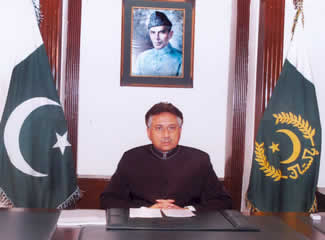
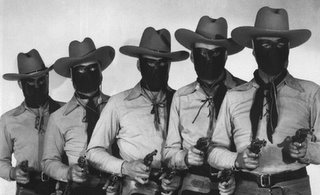
Musharraf the Mendacious


During his televised address to the nation on Tuesday night Musharraf, referring to the conflict in Balochistan, said:

"No action is under way now, only Frontier Corps will act in self-defence and deal with the anti-development elements."
Someone should ask him: Since when have helicopter gunships, air force fighter bombers, heavy artillery and mortars been handed over to the Frontier Constabulary?


_______________________________________________________

The reasons for Musharraf’s blatant mendacity are plain to see.

The fact is the military regime really couldn’t give a flying hoot (within certain given limits, of course) what the so-called English-speaking elite read in the Dawn, Nation, Daily Times and The News et al.

It is the vernacular press (Jang, Nawae-Waqt, etc) and those that read it, who are critical for Musharraf’s continued hold on power. What the ‘English-speaking elite’ probably fails to realise is that the vernacular press is kept firmly on a tight leash and continually fed with the regime’s version of events in Balochistan. By continually denying military action in Balochistan Musharraf is playing to the gallery of the millions of ordinary Pakistanis who, he hopes, will fall for the one-sided view that is constantly being presented before them.


Musharraf the Indecisive


On 12 December Musharraf came to the capital of Sindh and addressed editors and senior journalists of national and regional newspapers at the Governor House at Karachi.

Here are the salient excerpts from his address that I have extracted from the
Daily Times’s account:
  • ‘Previous governments had failed to make difficult decisions for reasons of political expediency and lack of courage’
  • ‘I am ... not of that sort. I have courage to face problems squarely’
  • ‘Consensus or no consensus, Kalabagh Dam will go ahead’.
Then he uttered something weird: “Let me tell you, the people of Punjab will topple any government which tries to shelve this project after it has started.” (This statement was corroborated by other
newspapers as well)

______________________________________________________

(For the record a fortnight later at a convention of opposition parties a resolution was passed which stated, as reported in
Dawn:
  • That Musharraf’s argument that Punjab would topple any government that opposed the Kalabagh dam was a testimony that he wanted to pit federating units against each other.
  • "It proves that Punjab is Pakistan and Pakistan is Punjab,” the two-page resolution read and warned that President Musharraf and his associates would be squarely responsible for any harm done to the integrity of Pakistan.)
_______________________________________________________

After over a month of snapping and snarling (I imagine that is what he feels a commando ought to do) at people expressing contrary views on Kalabagh Dam, guess what he does? He crumbles, eats humble pie and says: “Public opinion, mostly in Sindh ... is not fully on board. I respect this public opinion’ and opts instead for Basha and Munda Dams.

The General by raising the Kalabagh Dam issue managed to raise the hackles of large parts of Sindh, NWFP and Balochistan (the latter being already enraged about having to cope with Musharraf’s helicopter gunships and fighter bombers). Now it seems that his latest decision has caused his popularity to dip among some of most his sycophantic supporters from Punjab. (See:
Many cabinet members oppose KBD postponement – Daily Times).

Yet, as today’s
Daily Times editorial points out, there maybe a ray of good fortune for Musharraf despite having once again revealed his emblematic indecisiveness. The reversal on Kalabagh, the Daily Times believes, might lead to further disarray within the ranks of opposition parties.
The public reaction has proved that it was a good “retreat” to beat, so good in fact that it might actually be called an “advance”. ..The MQM is overjoyed and is now well set to extract as much mileage from it as it can at the expense of the PPP in Sindh. It has been distributing “sweetmeats” in the streets of Karachi saying that Altaf Hussain has “saved the people of Sindh” from disaster. As for the rest of the Sindhi opponents of the Kalabagh Dam, most of them had suggested that Basha should be built and they must now show grace by accepting what has been finally decided.
.… The PPP was at sixes and sevens on the issue. National-level leader Makhdoom Amin Fahim said quite clearly that he favoured the Skardu-Katzara Dam, most probably after hearing that the Sindhi head of the Technical Committee, ANG Abbasi, had proposed it. On the other hand, the Sindh-level leader Nisar Khuro had proclaimed that his party was opposed to any dam at all “because there is no water to store”. What stance will the PPP finally take?
The isolation of President Musharraf had prompted many to join the political bandwagon against Kalabagh Dam, including the PPP in Punjab. Since the PMLN has always been in favour of the Dam (“provided it is backed by national consensus”) it will stand to lose support at the home base if it cavils with what has been decided now. This will put the PPP, the largest party in the country, on the spot. It simply can’t afford to blunt its opposition to President Musharraf by appearing to agree. If Ms Bhutto decides the final position, she will have to cross this tough and divisive intra-party Rubicon. On the other hand, the MMA will have to rely on the trouble in FATA to retain the intensity that Qazi Hussain Ahmad seems to favour more than Maulana Fazl ur Rehman.
Which view is right? Only time will tell.


The Spin on the Missile Attack at Damadola


Trying to decipher facts from a multitude of disjointed news stories is never an easy task.

Let’s begin with the simple facts first:

At about 3 am on the morning of 13th January a series of powerful missiles fired from a CIA-controlled Predator drone destroyed three mud house compounds, killing some 18 men, women and children, in the village of Damadola Burkanday in tehsil Mamoon of Bajaur agency located in Pakistan’s NWFP Province.

Later a
new report informed us that the three mud house compounds belonged to the families of Bakhtpur, Muhammad Rahim and Bacha Khan.

Subsequently we obtained fresh knowledge from a Pakistani intelligence official who provided information to the
Guardian:

'The official said that hours before the strike some unidentified guests had arrived at the home of a tribesman named Shah Zaman.'
Another
source then informed us that the ‘suspect’ Shah Zaman was a brother of Bakhtpur (who died in the attack). So we may surmise, that in all likelihood, Shah Zaman and Bakhtpur lived in the same family housing compound as is the common tradition in most of the tribal and rural belts of Pakistan.

Apart from losing his brother Bakhtpur, the ‘suspect’ Shah Zaman also lost a number of his children in the missile attack. He told the reporters from the UK
Observer

'This is a big lie... Only our family members died in the attack,' said Shah Zaman, a jeweller who lost two sons and a daughter in the attack. 'They dropped bombs from planes and we were in no position to stop them... or to tell them we are innocent. I don't know [al-Zawahiri]. He was not at my home. No foreigner was at my home when the planes came and dropped bombs.'
________________________________________________________

As hordes of reporters descended upon the village, we heard from:

The
Associated Press who met with:

[Shah] Zaman's neighbour, Shamroze Khan, 55, [confirmed that] he had never noticed any foreigner in their compound before.

Then the
Guardian told us:

Local lawmaker Sahibzada Haroon ur Rashid, who visited Damadola soon after the attack, said the dead had been buried and that no foreigners were among them. They came from a local family of jewelers, he said, adding that none of the bodies was burned so badly that identification was difficult.

A reporter from Newsweek, who also reached Damadola, was also told the same thing by the villagers: only locals died. While there he came across Muhammad Rahim, one of the other owners of the destroyed mud house compounds. This how
Newsweek reported him:

Mohammed Rahim, 70, owner of one of the destroyed houses, wailed that several in his family had been killed. "I can't feed my own family. How could I afford to be hosting Zorayi?" he said, mispronouncing Zawahiri's name.
________________________________________________________

Could Shah Zaman have invited Zawahiri for dinner? I, for one, go along with BBC’s analysis:

The destroyed houses belonged to local jewellers, who had no history of taking part in religious or tribal politics.Analysts of Pashtun (Pathan) society say such people are not land-owners and do not command the kind of status or respect to invite a militant leader of the stature of Ayman al-Zawahiri for dinner, as some reports have suggested.

Early on an adamant senior Pakistani intelligence officer, commenting on CIA’s missile attack, told Associated Press’s Riaz Khan ( as reported in the Guardian) :

‘Their information was wrong, and our investigations conclude that they acted on a false information,'' said a senior intelligence official who has direct knowledge of the investigations launched by Pakistan to look into the attacks.’

________________________________________________________

And so we have a picture, not precisely clear but enough for our purposes to draw the following conclusions:

  • It was Shah Zaman whose house was targeted by the CIA because the agency ‘believed’ that Zawahiri would be his overnight visitor at the time of the attack.
  • There were no members of the Al Qaeda present. Though at a stretch, even if on the remote chance there were outsider guests present, they would have been fellow Pathans from Afghanistan, but not necessarily terrorist though - perhaps religious and therefore pro-Taliban as many of them tend to be.
And now, believe you me, we are told that some fellow by the name of Fahim Wazir, apparently the Political Administrator (equivalent of a DCO) of the Bajaur region, has announced:
"At least four to five foreign elements had also been killed in the incident, but their bodies were removed from the scene within no time by their companions, so as to suppress the actual reason of the attack," (New York Times).
The logical question then becomes: Since when, under a military regime, does a lowly Tribal Area PA have the cojones to make such a dramatic and completely unsubstantiated allegation to the world press?

Herein lieth the answer - under an appropriately titled piece
Confusion Shrouds Pakistan Attack -Regional Officials Report Foreign Militants Killed the Washington Post, while reporting Fahim Wazir’s unsupported claim, quite shrewdly notes:

‘The Pakistani report bolstered earlier U.S. assertions of strong pre-strike intelligence that a group of al Qaeda figures was in the immediate area.
The picture becomes suddenly obvious - yes, while there were no ‘terrorists’ in Damadola, the military regime has to ensure its survival. So now we can see a two-pronged approach emanating from Islamabad:
  1. Placate the infuriated local populace by allowing Pakistani diplomats to ever so hesitantly take the US ‘to task’ so that it can be splashed all over in the Urdu press.
  2. Then soothe the embarrassment of the CIA - and possibly appease the US intelligence agency's anger at having been provided faulty information from Pakistan - by suggesting to the world that Americans may have been right all along, as it was simply a case of sheer bad luck that prevented them from getting their target.
So tell me who is kidding who?


Monday, January 16, 2006

WSJournal Reprimands Musharraf on Balochistan Crisis


A timely opinion from US capitalism’s watchdog – The Wall Street Journal.

It calls for the democratization of Pakistan and not surprisingly accuses the military of fudging the real issues behind Balochistan’s discontent, as well as noting the similarities between the Khaki stupidities of 1971 and today.


______________________________________________

Wall Street Journal on Balochistan
By Federic Grare ( French expert on South Asia) & Georges Perkovich (Vice President for Studies at the Carnegie Endowment for International Peace)

If you can’t find Balochistan on a map, you’re not alone.


Here are some clues: It’s next to Iran and Afghanistan. It’s the biggest province in Pakistan, the one where the most of the oil and gas rigs are. Lots of Chinese can be found there, because they are building an enormous commercial and military port in Gwadar, at the mouth of the Persian Gulf. There are two military bases from which US forces fight the war on terrorism.
Don’t plan a trip to Balochistan any time soon, though. It’s recently come under fire from troops, helicopter gunships and fighter bombers – sent by the West’s favourite military ruler, Gen Pervez Musharraf.


Balochistan, which has a literacy rate of 25 percent (3 percent for women), has never been integrated into Pakistan. Neither Balochistan’s rough tribal leaders nor the Punjabi-dominated elites of Pakistan have been able to rise beyond an uneasy colonial relationship. The current Baloch insurgency is the fourth in 67 years.

Since 9/11, the US government has downplayed the importance of democratic reform in Pakistan, and Balochistan shows why this is a dangerous mistake. Repression by the military-dominated central government will only exacerbate Pakistan’s instability and economic problems. The two US bases in Balochistan – and cooperation needed in combating terrorism in Afghanistan – could be compromised. Chaos in Balochistan could also aggravate competitive Sino-US relations in the region.

The Baloch have three main grievances that all reflect a general sense of being exploited as a colony by Punjab, the most powerful and populated province of Pakistan.

They demand a fairer share of royalties generated by the production of natural gas in their province. The federal government pays a much lower price for each unit of gas produced in Balochistan than it does for gas produced in other provinces. Moreover, Balochistan receives no more that 12.4 percent of the royalties generated for supplying gas.

The people of Balochistan want to be included, rather than marginalized, in the huge development projects the central government has brought to the coast, particularly the Gwadar port. There is no technical school or college in the area to train locals for future participation in the development projects. Those employed so far have been only daily wage labourers.

They also reject the Punjabi-dominated army’s establishment of new military cantonments in their province, and the selling at nominal prices by the central government of choice coastal property to out-of-province developers.

In other words, the Baloch want Balochistan for Balochis, not for others.

The government replies that Balochistan’s resources are national property and has made only nominal concessions. The conflict, it says, is the fault of a few greedy obscurantist tribal leaders opposed to the development of the province.


This argument resembles that which the Punjabi-dominated central government made in the early 1970s towards East Pakistan before massive violence and war with India erupted, leading to the creation of Bangladesh. Similarly the Musharraf regime has responded with military force, air strikes, and – according to some reports – the use of napalm.

The military rulers are more fearful of the situation than they admit, and have tried to conceal the real nature of the conflict in different ways. Balochistan is an anti-clerical province whose tribes have nothing to do with the sort of Islamism of the Taliban or Al Qaeda. Yet the Pakistani government has tried to tar the Baloch with the Islamist brush, in part to keep the international community from paying more attention to the real problems in the province.

The central government in Islamabad also has sought to blame the unrest on ‘foreign hands’, with the main culprits being India, Iran and the US, depending on who the audience is. Lately, the government says ‘criminal elements’ lay behind the insurgency.

The truth is that the development level is abysmal throughout the province. Many of the Balochis’ claims could have been satisfied without jeopardizing the country’s territorial integrity. The leaders of the Baloch nationalist movement have made it known that they would be satisfied with a generous version of autonomy. Instead, the conflict is now spreading.

Reconciling conflicting interests and seeking fair allocations of the costs and benefits of development is what governments are supposed to do. And history suggests that democratic governments, for all their drawbacks, tend to produce fairer allocations that dictatorships do.

By contrast, the manipulation of the 2002 elections, which gave the provincial government to a coalition of conservatives and Islamists, deprived the Baloch nationalists of any say in the allocation of resources.

Balochistan is yet another example of the risks of postponing democratization in Pakistan. The outcome could be a major civil war, whose consequences on regional stability and the war against terrorism are likely to be unpredictable – and anything but positive.

_________________________________________________________


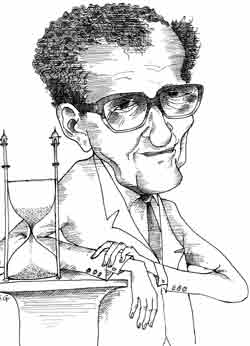
Spot On!


Accurately capturing the barefaced Lie

(Cartoon by Zahoor in today’s
Daily Times)

A Modern Sage’s Advice for Indians


In his latest book ‘The Argumentative Indian’, Amartya Sen - the sage from Bengal as Tariq Ali calls him - offers some wise and sensible advice to his compatriots on their dealings with neighbouring Pakistan.


He writes:


[No] country has as much stake as India in having a prosperous and civilian democracy in Pakistan. Even though the Nawaz Sharif government was clearly corrupt in many ways, India’s interests are not well served by the undermining of civilian rule in Pakistan, to be replaced by activist military leaders. Also, the encouragement of cross-border terrorism, which India accuses Pakistan of, is likely to be dampened rather than encouraged by Pakistan’s economic prosperity and civilian politics. It is particularly important in this context to point to the dangerousness of the argument, often heard in India, that the burden of public expenditure would be unbearable for Pakistan, given its smaller size and relatively stagnant economy, than it is for India. This may well be the case, but the penalty that could visit India from an impoverished and desperate Pakistan, in the present situation of massive insecurity, could be catastrophic. Strengthening of Pakistan’s stability and enhancement of its well-being has prudential importance for India, in addition to its obvious ethical significance. That central connection – between the moral and the prudential – must urgently be grasped.
Amartya Sen, The Argumentative Indian – Writings on Indian History, Culture and Identity, Allen Lane, UK, 2005, pp. 268-269.


Sunday, January 15, 2006

Drones, Lies and Violent Deaths


On 13th January missiles ripped through three village compounds in the Bajur tribal area of the NWFP Province. They ended up killing 18 innocent Pakistani civilians. The dead included 14 members of a single family. Among those killed were four children, aged between five and ten, and at least two women.

According to next day’s
Dawn:
Government officials, who spoke on the condition of anonymity, said that four aircraft violated the country’s airspace and entered the tribal area from Afghanistan’s troubled Kunar province at about 3am. The intruding aircraft fired at least nine missiles at houses in Damadola…
Soon afterwards the US Defence Department denied that the US military had carried out any attacks in the area (source:
Forbes)

It was the
Washington Post that broke the news by reporting that the attack had been carried out by the CIA. According to the newspaper, the US intelligence agency had used one of its armed drones to carry out the attack and the intended target had been the al-Qaeda's deputy, Dr Ayman al-Zawahiri.

Then quoting a US intelligence source the US newspaper further revealed:

"[The missile strike] would not have happened without Pakistani involvement," the source said, adding that Pakistanis were "heavily involved." He said the attack was planned and executed by a combination of CIA officers in Pakistan and Pakistani officials.
Ouch!

Your Blogger has come to learn that when Pakistani officials went to Damadola on 14th January to obtain DNA samples from the dead (to ascertain whether Zawahiri had been killed), they were chased off by a violently incensed mob of villagers.

In any event, it turns out that Zawahiri (who apparently is married to a lady from the Mohmand tribe - the majority population in Damadola village) was not present at the time of the missile attack. A senior Pakistani intelligence has already confessed to the UK
Independent, "He was invited for the dinner, but we have no evidence that he was present".

Not surprisingly our pro-US military ruler soon found himself struggling to overcome the embarrassment caused by the attack, especially since there was no dead Zawahiri to crow over.

And having been directly implicated in the debacle, our military regime desperately attempted to salvage the situation. As the UK
Observer reported yesterday:

In a bid to distance themselves from what was looking like a tragic and counter-productive tactical error that had cost many innocent lives, Pakistan announced it would file a formal protest with the Americans. Information Minister Sheikh Rashid Ahmed told a news conference that the Pakistani government wanted 'to assure the people we will not allow such incidents to recur,' adding that the government had no information about al-Zawahiri.
The regime’s task is not going to all that easy. As Pakistani journalist Farhan Bokhari writes in the UK
Financial Times:
"If anything, the fallout from this attack only ensures greatly popularity for anti-Musharraf and anti-US elements in this country," warned an Arab diplomat in Islamabad.
Analysts said mounting public distrust of the US had once again exposed General Musharraf's political isolation. Notwithstanding his pretence of being a liberal leader, Pakistan's main liberal political parties remain opposed to him.
"The fallout from this attack has just turned itself in to a big fiasco for General Musharraf and his US backers. This is a disaster for Musharraf. It's evidence for the people of Pakistan that the US indulges in gangsterism on their soil," warned Hasan Askari Rizvi, a Pakistani commentator on security affairs.
Lieutenant General Talat Masood, retired from the Pakistani army and now a defence and security affairs analyst, said the attack had prompted new questions over "the quality" of Pakistan's alliance with the US.
"Can the Americans come on your soil, fire upon and kill your citizens and the government doesn't have information of this attack in advance? Is there a missing trust element in all of this?That's what many Pakistanis would like to know," he said.
Yesterday thousands of protestors took to the streets in Karachi, Lahore, Islamabad and Peshawar to vent their anger at the United States and Musharraf – one of their chants targeted Musharraf directly, according to the Daily Times, the demonstrators screamed in unison : ‘Any Friend of America is a Traitor’.

____________________________________________________________

Since late 2001 the Pakistan regime has ceded control of several of its air bases to the US – these being the air bases located in
Jacobabad, Dalbindin, Pasni and perhaps Shamsi. According to the Global Security Org website, both Jacobabad and Pasni bases have been sealed off with a 5km cordon being set up around the bases by our military.

The main US base is at Jacobabad which
reportedly hosts small teams of the CIA, FBI, and Special Operations Forces.

Recently your Blogger was informed that a locally manufactured drone was undergoing operational testing when it was brought down by the US forces based in Jacobabad. It caused some local bewilderment as a source tells me that the Americans had been pre-warned of the drone’s flight path. One can therefore only surmise that these US teams based in Pakistan are beholden to no one, other than, of course, their own US authorities.


And Now For A View from the Baloch Side...


I must confess that I am not an expert on the problems of Balochistan. So for the past few days I have spend time researching the Internet for a few answers.

Among the various bit of facts and information that I was able to piece together the following was particularly provocative and quite illuminating.


On a Balochi Radio Website one Nizamuddin Nizamani (who is apparently a trainer and social researcher in the field of Sustainable Development, Conflict Management, Peace and Mediation studies) asked the following two very pertinent questions:

(This excerpt has been edited for clarity’s sake - the original can be viewed at
Radiobalochi.org)
If sardars and their tribal system are the fundamental reason for the underdevelopment of Balochistan, then limited as they are to only 15 to 20 percent of territory, the remaining 80 percent of the Baloch region can be detached from their ill-affects. All the coastal line, plains and mountainous areas stretching from Gawadar, Pasni, Jewani, Ormarah, Turbat right through the Mundh near Iranian border on one side, from Quetta, Chaghi, Kharan towards Iranian border and the whole of Lasbella, Hub down towards Karachi are not subject to any form of tribal system and are therefore are out of the clutches of these tribal sardars. In view of this reality, why then does this incredibly large sardar-free zone continue to be grossly underdeveloped?

If sardars are indeed the major obstacles towards progress then the federal regime must hold itself responsible for this grim and bleak situation, as according to General Musharaf,
72 out of 75 sardars, are with the government. From this we can only conclude that 72 sardars, in connivance with federal government, have deliberately deprived Balochistan from any technological development. And it is also worth asking, considering Islamabad has such a large horde of Baloch sardars by its side, why the Establishment is been unable to resolve the Balochistan crisis?

This clearly reveals that the true problems of Balochistan do not lie with the tribal structure nor with the so called sardars, but somewhere else.
And now follows an assorted and lengthy - please bear with me because I believe it well worth a read, so take your time! - collection of hyperlinked facts and opinions for readers to ponder over and make their own conclusions

_________________________________________________________________

The Military Government says : thousands of local jobs will be provided by the planned the Gwadar Naval Base, the three proposed Military Cantonments (at Sui, Kohlu and Gwadar), the Mega-Projects and fresh recruiting within the paramilitary organizations.

Absolute nonsense say the Baloch.

This was indirectly verified by this month’s
, Newsline magazine, which said:
‘The Ormara naval base is another big project which has come up on the Makran coast, but Balochi nationalists maintain that the development of the second largest naval installation has not helped improve the socio-economic conditions of the local population. According to Baloch leaders, only 40 people in a population of more than ten thousand, have been given employment - and that too as daily wage workers. No educational institution has been established in Ormara town and electricity is available for only a few hours a day.’
Rashed Rehman, a well known newspaper editor from Lahore, is also on record stating that:

…projects such as the copper extraction plant in Saindak, built and currently being operated by Chinese contractors [where] no Baloch are employed.
And then one of the regime's loathed Baloch opponents, Sardar Attaullah Mengal, quoting official governments figures in the Daily Times went on to state:

That of the total 33,275 personnel of the Frontier Constabulary deployed in Balochistan, only 300 were from the province.

That only three percent of the coastguards deployed in Sindh and Balochistan were Baloch, 62 percent were from Punjab, 19 percent from Sindh and 16 percent from the NWFP.

He further added:
That the government has established 584 checkpoints in Balochistan, and if this were divided with the population of the province, it came to one checkpoint for 11,000 people, he said. India and Israel had set up fewer checkpoints in Kashmir and Palestine, which showed the government’s intentions to maintain its “stranglehold” on the province.
To the best of my knowledge no government spokesman has ever refuted Attaullah Mengal’s figures
_________________________________________________________________


And now to Akbar Bugti and Sui.

Apparently in 1952 – or whenever the Government of Pakistan signed its deal with him – the Nawab owned all the land in Sui and the surrounding area. And so the Government – then based in Karachi – agreed to pay him an annual lease rental for his land. As the leased land amounts to thousands of acres the existing lease payment now made by Pakistan Petroleum Ltd. (PPL) runs into crores – Rs, 10 crores according to
The Daily Times.

This happens, I am told, to be a legally binding agreement and has no connection with royalty payments to the province of Balochistan. It makes sense as some years ago I heard Hameed Haroon (Chief Executive of Dawn newspaper) say that one of the reasons Akbar Bugti was miffed with PPL was that the company had deliberately tinkered with the measurement of his leased land and was underpaying him. On the other hand the Islamabad regime insists in calling these payment ‘extortion’. So instead of constantly yelling blue murder, why doesn’t PPL take Akbar Bugti to court to resolve their contractual disagreements? (At least then the true facts of the matter will finally emerge in the public eye).

Now as far as paying royalties for the gas at Sui to the Balochistan province the facts would seem to clearly support the Baloch.

As Dawn’s Zubeida Mustafa’s states in a
recent article:

The record of exploitation of the Baloch has been horrendous. Gas was first discovered at Sui in 1952 but it was only in the eighties when General Ziaul Haq decided to make Quetta a corps commander headquarters that the city was connected with the gas fields.

Even today, only six per cent of the population of Balochistan has been provided gas. As for the price paid to the province for the gas extracted from Sui, Balochistan feels severely discriminated against. Its sense of injustice is substantiated by the figures available. Punjab, Sindh and NWFP receive royalty on gas and oil at a higher rate than Balochistan - Rs 140 per million BTU for Sindh, Rs 80-190 for Punjab and Rs 36 for Balochistan. Besides the development surcharge calculated on the formula worked out by the NFC for the federal divisible pool is on the basis of population and that goes against Balochistan with only six million people.

So much for Islamabad’s much proclaimed high moral ground!
____________________________________________

Then there is the explosive issue of Gwadar.

Some years ago a
Dawn editorial pointed out:

[The] fear of dislocation expressed by certain sections is not totally unfounded. Since the construction of the [Gwadar] port began last year, some real estate racketeers and land mafia operatives from Karachi, Lahore and other big cities have done a roaring business buying land from the local people at nominal prices and selling it off to the moneyed people and multinationals at exorbitant rates. As work progresses on the construction of the port and the infrastructure, land grabbers are making quick bucks at the expense of the local, mostly small, landowners using pressure tactics and influence with the officials forcing the owners to sell their land and relocate to the desert outside the city.
And very recently Dawn’s senior journalist Zubeida Mustafa added:

The government leaders — from the president and prime minister to petty functionaries — have been promising that development of the port area will generate jobs and economic benefits for the local population. So far, this has not happened and the technical hands and workers who are being brought from other regions by the non-Baloch contractors have reinforced the beliefs of the nationalists that Gwadar will change the ethnic composition of the province by allowing the induction of a large number of people from other provinces.
Apart from not getting any jobs the Baloch further allege:

That the military authorities have bought most of the prime land at throw-away prices are rife. According to local officials, over 80 per cent of the plots in the Gwadar Singhar Housing Scheme have been arbitrarily allotted to outsiders, many of them senior army and civilian officials.
____________________________________________


Now getting back to Lahore’s
Rashed Rehman. According to him:

The Musharraf regime's plan to build a Rs. 100 billion road network to link the province with the rest of the country and enable it to become the hub of trade with China and Central Asia through the Gwadar port is eerily reminiscent of earlier such schemes under previous regimes. For example, when General Ziaul Haq made 'peace' with the Baloch guerrillas of the BPLF, he unveiled a US$ 1.97 billion (Rs. 120 billion at current rates of exchange) Special Development Plan for Balochistan, with a US$ 765 million road construction component. Before him, Bhutto had boasted of similar plans and achievements during the years of the fourth Balochistan war.

Baloch nationalists argue that the location of many of the new roads was not determined by economic priorities, but to allow the army to penetrate the otherwise inaccessible guerrilla base areas. Even where roads were put down to open up exploration for oil, the nationalists contend the resulting profits would flow to the Central government and foreign oil companies rather than to the province. Similar reservations are expressed about Gwadar and other mega projects. The fact that in 2005, the Musharraf regime is again announcing such programmes for Balochistan is not simply because of the new opportunities of trade with China and Central Asia, but also indicates how much of these recurring plans have remained on paper only.
_______________________________________________________________

In final I’ll quote Senator Maheem Khan Baloch of the Balochistan National Party (Awami), who told
The Daily Times:

The Baloch [ want] a fair quota in federal government jobs, gas royalties, a just solution to the National Finance Commission award controversy and bigger budgetary allocations from the centre.He said the province was rich in natural resources and contributes huge sums to the national exchequer, but local concerns about increasing poverty, unemployment and lack of civic amenities had been ignored.

He said the parliamentary committee on Balochistan should be given a “free hand” to find a solution to the concerns and grievances of the Baloch.

In your Blogger’s opinion it is a fair request, so I can’t help but agree with this Baloch senator.

On the other hand, to me, killing Baloch citizens of Pakistan for demanding their rights is not only stupid but a clear and barbaric crime not only against Pakistan but against the concept of God's law of natural justice.


Saturday, January 14, 2006

Musharraf is Lying Yet Again...So What's New?


Like most liberal thinking-Pakistanis, to me the situation in Balochistan is fast becoming more than a cause for worry – it has instead become a critical reflection of Pakistan and what we Pakistanis endeavor to stand for.

With ordinary Pakistani women, men and children dying, thanks to our military's ‘collateral damage’, it becomes obvious that our Commando-in-Charge has become enamoured with the superb power of mendacity and barefaced dishonesty.

Putting it in a nutshell, Musharraf is probably of the view that as the greater ‘unwashed’ Awam is ‘naively illiterate and gullible’ it is only through prodigious lying that his stint in power can be further secured.


Zahid Hussain is a well-known and respected Pakistani journalist. Here is what he has to say in this month’s
‘Newsline’.

__________________________________________________________

Musharraf's Other War
By Zahid Hussain


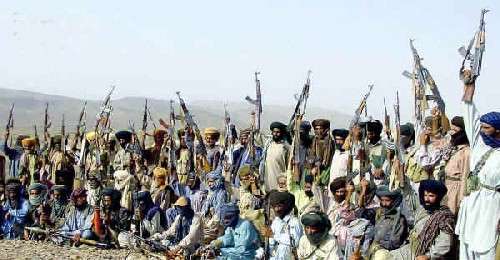
The treacherous terrain made it an ideal location for guerrilla warfare. A thin-framed man with a cropped beard, Karim Baksh leads a group of Baloch guerrillas dug into position under a huge rock on the edge of a dusty road, a few miles away from a government paramilitary post. The ricocheting of machine-gun fire echoes in the distance.

"Let them come here, they will not be able to go back alive," Baksh laughed, stroking his Kalashnikov rifle. The others nodded approvingly. "Our men are spread all over," he claimed, pointing his finger towards the brown, parched hills. There were only a few thatched hutments scattered around the vast, barren land. The treacherous terrain made it an ideal location for guerrilla warfare.

The guerrillas, who claimed to be members of the shadowy Balochistan Liberation Army (BLA), appeared well trained and were armed with machine-guns and rocket-launchers. One of the men was constantly on a wireless set receiving information about the movement of government troops. The fighters were from both the Bugti and Marri tribes. It was certainly, by far, a different outfit to the groups that confronted the Pakistani army with bolt rifles in the 1970s. Some of them were veterans, while others belonged to a new generation of fighters who were getting a crash course in guerrilla warfare.

A school dropout, the 30-year-old Baksh took up arms almost a decade ago. "It was difficult to continue my education after the tenth class and I could not find any employment," he said. The others were even less fortunate. They never went to school at all and got involved in the conflict at a very early age.

Javandan sat quietly in a corner, playing with his rifle. His neatly curled black beard and greenish eyes betrayed his Marri antecedents. He seemed to be the most experienced of the group. "We are all united now in the struggle," he said, finally breaking his long silence.” They are bombarding our areas and killing innocent people. We don't have any choice but to fight."

The BLA, whose name first emerged during the 1970s, originally comprised mainly the Marri tribesmen loyal to Nawab Khair Baksh. But later its composition changed with members of the Bugti and Mengal tribes joining its ranks. Today, the BLA boasts many members from an educated, middle-class background. The present conflict in Balochistan has, for the first time, united the educated Baloch with the tribesmen. "People feel that they won't get their rights through democratic and legal means," said Dr. Abdul Hayee Baluch, a leader of the Balochistan National Party.

It is the first time that the two largest Baloch tribes have set aside their differences to join hands in the struggle. The Bugtis sat on the fence when the Marris led the armed insurrection in the1970s. More than 6000 Baloch and around 3000 soldiers were killed in the bloody conflict, which ended after General Zia-ul- Haq declared amnesty and allowed Khair Baksh to return home from his self-exile in Afghanistan. Thousands of Marri fighters received weapons training in Afghanistan during that period and they form the nucleus of the guerrilla forces now fighting in Balochistan.

Though the primary loyalties of the Baloch insurgents may lie with their tribal chiefs, they also appeared to be politically aware, religiously listening to the BBC Urdu service whenever possible. "What are you fighting for?" I asked. "We want the right of self-determination," they replied in unison. They were obviously well tutored.

The BLA resurfaced after the arrest of Khair Baksh in 2000, on charges of the murder of a high court judge. Initially the government dismissed the existence of the BLA, but now senior security officials concede that the group is behind the current insurgency. Intelligence agencies have accused the BLA of receiving financial aid and weapons from India. "We have evidence that the insurgents are getting help from India and some other countries which are not happy with China's involvement in the construction of Gwadar port," says a senior security official. Some intelligence officials claim that Indian intelligence agents were providing guerrilla training to the insurgents. These allegations, however, are rejected by Baloch leaders.

The BLA operates a website, "Baloch Voice," which carries reports of their actions. It has its own flag and national anthem. Its spokesmen, who identify themselves as Azad Baloch, Meerak Baloch and Col. Doda Baloch, regularly call newspaper offices in Quetta. The group is believed to have more than 5000 well trained men in its ranks. Though the identity of its leadership remains secret, it is reportedly led by Ballach, the younger son of Khair Baksh. A sitting member of the Balochistan assembly, Ballach, who is a graduate of Moscow University, is one of Pakistan's most wanted persons. His brother Meheryar, a former provincial minister now based in Dubai, is also part of the BLA leadership.

Pakistani security forces find themselves locked in a new and even fiercer battle in Balochistan. Baloch nationalists have led four insurgencies - in 1948, 1958-59, 1962-63 and 1973-77 - which were brutally suppressed by the army. Now a fifth is underway and this time the insurgents are much stronger. They are armed with more sophisticated weapons and possess a modern communications system. Can an already overstretched military deal with the increasingly volatile situation in Balochistan ?

Balochistan has remained relatively quiet for almost two decades and the return to civilian rule in 1988, brought the Baloch nationalists into the political mainstream. Although their major demands relating to natural gas royalty and allocation of resources remained unfulfilled, democracy, at least, provided the Baloch a sense of political participation. The tension started mounting a few years ago when the military government announced its intention to set up three new cantonments in Balochistan. The move was seen as a means to further tighten federal control over the province and the apprehension was not without basis. The problem of Balochistan has been chronic and is a direct consequence of an over-centralised system. The fresh deployment of army personnel further fuelled the discontent.

Under the current constitutional arrangement and the practices that have grown around it, economic resources and political power are concentrated with the federal government. The situation in Balochistan has been particularly worse, and even the maintenance of law and order is the responsibility of the federally controlled paramilitary troops. The master-servant relationship is much more stark in Balochistan than in any other province. The return of military rule has further aggravated the situation, and even the present pro-military provincial government wields no real power.

The federal government has completely ignored the long-standing demands of the nationalists to review the royalty formula on Sui gas, which had remained constant since 1952, and increase the province's share in the NFC award. Despite the government's claim of spending 120 billion rupees on mega-projects, there has not been much change in the lot of the locals, who remain the most deprived and backward section of society.

Despite such massive investment in the province, feelings of resentment against the centre run deep. There is an underlying fear that the benefits of these projects will not reach the local population and will be siphoned off to the Punjab instead. The nationalists have strong reservations on the construction of a new deep-sea port in Gwadar. They fear that the mega-project, which is being developed with the help of China, will lead to a massive influx of outside workers and turn the local population into a minority. The nationalists maintain that the project has been launched without taking the Baloch representatives into confidence. They contend that the Baloch would hardly benefit from Gwadar, or indeed any other mega-projects, as most of the jobs in the federally controlled organisations would go to the Punjab and other provinces according to the quota system. Meanwhile, land grabbing by the military further exacerbated the situation.

The Ormara naval base is another big project which has come up on the Makran coast, but Balochi nationalists maintain that the development of the second largest naval installation has not helped improve the socio-economic conditions of the local population. According to Baloch leaders, only 40 people in a population of more than ten thousand, have been given employment - and that too as daily wage workers. No educational institution has been established in Ormara town and electricity is available for only a few hours a day. Similarly, the Bugtis complain that they too are not given jobs at the Sui gas plant.

It is ironic that Balochistan, which fulfils 50 per cent of Pakistan's gas requirement and is rich in mineral resources, finds it difficult to pay the salaries of its employees. Balochistan has sought a loan of around 24 billion rupees from the Asian Development Bank at the direction of the federal government, to service foreign and federal debts amounting to 44 billion rupees. Due to its extreme financial crisis, its overdraft with the State Bank has gone up to14 billion rupees. Apart from debt-servicing foreign and federal loans, the Balochistan government pays 200 million rupees per month to the State Bank in interest for the overdraft. While President Musharraf has admitted that the province has faced injustice in the distribution of resources, a long-term solution to the problem has yet to be found.

The government often accuses Baloch tribal chiefs of blackmailing the centre and opposing development work in the area. Though this may be true to some extent, interestingly enough, the majority of the chieftains, particularly the most retrogressive ones, have always sided with the establishment. And while corruption is endemic, again it is the establishment itself that is responsible. Patronage and bribes are commonly used establishment tools to buy loyalties of corrupt politicians and perpetuate their own control.

The situation exploded last year when Bugti tribesmen, protesting against the rape of Dr. Shazia Khalid in the high-security PPL residential compound guarded by the army's elite Defence Security Group, blew up the gas installations at Sui, disrupting gas supply to the Punjab and other parts of the country for several weeks. The subsequent armed clashes between Bugtis and the security forces resulted in scores of deaths. The stand-off ended after both sides agreed to pull back from their positions and the federal government gave an assurance to implement the Senate Committee Report on Balochistan. But the promise never materialised.

Musharraf and the military leadership were not prepared to concede to Balochistan's genuine economic and political demands. Instead of addressing the Baloch grievances politically and through negotiations, the military-led government has resorted to greater use of force. Musharraf threwfuel on the fire last year when he declared :"Don't push us. It isn't the 1970s when you can hit and run and hide in the mountains. This time you won't even know what hit you." The comment provoked a strong reaction from the Baloch leaders who warned the army not to create a 1971-like situation which led to the disintegration of the country.

Sporadic incidents of violence continued after the Sui incident, but the situation flared up last month after the insurgents launched a series of rocket attacks during President Musharraf's visit to a newly constructed army garrison in Kohlu. According to informed sources, some of the shells fell less than a 100 yards from Musharraf. It was a close call. The next day a rocket hit an army helicopter carrying the Inspector General , Frontier Corps, Maj Gen Shaukat Zamir Dar, and his deputy, Brigadier Saleem Nawaz.

Following those incidents, security forces mounted a massive operation in the Marri area using air force jets and helicopter gunships. The military authorities claimed the offensive was directed against "miscreants" and aimed at destroying "terrorist camps," but many women and children were are also reportedly killed in the bombings. Senator Sanaullah Baloch alleged that security forces used poisonous gases against the people. According to official and unofficial sources, the security forces also suffered huge casualties during the operation in the Marri area.

The ongoing operation has now been extended to many other areas and thousands of paramilitary and regular troops with heavy machine-guns and artillery have been moved into the Bugti areas.

Dera Bugti looks like a town under siege, with heavily armed paramilitary troops positioned on the surrounding hills and check posts set up at the entry points. All the posts vacated by Bugti tribesmen after the March agreement have now been occupied by army troops. Heavy artillery guns and armoured cars are deployed all along the roads leading from Sui to Dera Bugti.

"It is a war now," declared Akbar Bugti, who is confined to his bullet-ridden fort. A mortar attack in March had left a huge crater on the roof of his living room and 60 of his tribesmen were killed in that attack. He himself narrowly escaped death, when a splinter brushed past his head. Heavily armed tribesmen, with flowing beards and huge turbans coiled around their heads, guard the place. Some of them have taken up positions in the bunkers around the fort.

The white-bearded charismatic tribal chieftain, who is in his late '70s, accused the government of colonising Balochistan. "We are fighting for the control of our national wealth and for our political rights," he said. The Bugti tribe owns the land which contains Pakistan's largest natural gas fields. But the majority of the tribesmen live in abject poverty, with no employment or basic health and education facilities. " We are not scared and will fight back," he warned, sounding bitter over the government's backtracking on last year's agreement. "The troops sneaked in under the cover of darkness, into positions which we had vacated under the agreement. They do not want peace. They are mistaken if they think they are superior and can eliminate us." His grandson is being accused by military authorities of being involved in the bombing incidents in Karachi and Balochistan.

The conflict has already taken a huge economic and political toll. Billions of rupees are being spent on the establishment of cantonments and the deployment of troops. However, the use of brute force has only aggravated the situation. Hundreds of people have been killed in this war, which seems to have no end in sight. Several government soldiers have been killed over the past few weeks as the insurgents intensified attacks on security forces, key economic and government installations and railway tracks.

Bugti warned that the Baloch were much better prepared to fight the army now. "Musharraf is right that this is not 1970. He will not know what has hit him," he laughed. Heavy fighting broke out as we left Dera Bugti.


http://technorati.com/tag/Musharraf rel="tag">Musharraf


Thursday, January 12, 2006

The US Finally Fed Up With Musharraf?


Can this be true or is it simply an excercise in wishful thinking?


_________________________________________________


From Asia Times

Jan 12, 2006

US turns against Musharraf
By Syed Saleem Shahzad


KARACHI - Pakistani President General Pervez Musharraf seized power in a military coup in 1999 and, as commander-in-chief of the armed forces, still in effect rules as a military dictator.

Musharraf's firm grip on the affairs of state has until now served Washington's interests well, as he has been able to steer the country into the US camp as an ally in the "war on terror".

However, with the Taliban nowhere near defeated in Afghanistan and Osama bin Laden and al-Qaeda still unbroken (the two major reasons that the US solicited Pakistan's assistance in the first place), the US is looking at its allies in Islamabad in a new light: Musharraf may be more the problem than the solution.

An indication of how things have slipped in the region is news that Afghan President Hamid Karzai has openly called for a truce with Taliban leader Mullah Omar. This was not how events were supposed to play out.
According to sources close to the power corridors in Washington who spoke to Asia Times Online, the administration of US President George W Bush is now convinced that a weaker Pakistani army is as necessary now as a powerful one was when Islamabad did a U-turn on its support for the Taliban soon after September 11, 2001.

This realization has taken root over the past few months, and developments since last November have been enough to set alarm bells ringing among the military leadership of Pakistan.

Goings-on in Balochistan

Rebellious tribesmen in the restive but resource-rich province of Balochistan have for decades challenged the writ of the central government in Islamabad. The Baloch insurgents have traditionally received weapons via Kandahar in Afghanistan, and via sea smuggling routes.

The Pakistani army has engaged in a number of operations in Balochistan over the years, and the most recent is continuing. The involvement of the military is highly unpopular not only among Balochis, but also among many segments of Pakistani society.

What is new in Balochistan, and which is causing concern in Islamabad, is the emergence of two sons of insurgent tribal chief Nawab Khair Bux Muri as organizers of a strong financial network to fund the insurgency.

"The whole operation of financing the Baloch insurgency is directed from Qatar, although this is a very unlikely place. One of the sons of Khair Bux Muri - Gazn Muri - has been shuttling between Qatar and the UAE [United Arab Emirates] and is the main financial link between the insurgents in Balochistan, where command is in the hands of a brother, Balaach Muri," a top Pakistani security official told Asia Times Online.

"The real question, though, is not the transmission of money, but from where Gazn Muri is getting this kind of huge money. The answer lies in the activities of another brother, Harbayar Muri, who is based in London."
Although the official would not spell it out in as many words, he was questioning how Harbayar Muri could raise funds in Britain, where there is a negligible Balochi expatriate community. It was a clear hint at the involvement of Western intelligence agencies, which have strong centers of operations in Qatar-UAE and London.

Political maneuvering

The US is also making some backroom political moves in relation to Pakistan's interests in the region.

According to a contact who spoke to Asia Times Online, a person close to the US Central Intelligence Agency paid a low-profile visit to New Delhi in the third week of December and briefed strategic planners on Washington's plan to try to curtail the role of the Pakistani army, while at the same time renewing support for democratic forces in Pakistan.

India's cold shoulder on the diplomatic front toward Pakistan and a policy statement against the military operation in Balochistan was an immediate outcome. Islamabad promptly responded by accusing India of meddling in Balochistan, charges that Delhi strenuously denied.

The same person then visited Islamabad and held high-level meetings with political personalities. On his return to the US he stopped over in Dubai in the UAE and held detailed meetings with former Pakistani premier Benazir Bhutto, who lives there.

A sudden upsurge in the activities in Pakistan of the Alliance for the Restoration of Democracy - which Bhutto supports - followed.

Musharraf's mystique

The US first made contact with Musharraf in a meaningful way when he was still Corps Commander Mangla and he approached the Americans through a Pakistani mediator. Musharraf had no particular request, but the move was seen as "unusual and meaningful".

The US concluded first that he was ambitious and only wanted power, and that he had a flawed, "split" vision.
US officials noted that to build a constituency in the Pakistani Army, Musharraf embraced the Kashmir issue and enthusiastically supported the liberation movement there.

Last year's earthquake in Kashmir, in which the extensive jihadi influence in Pakistan-administered Kashmir was made clear (they played a significant part in relief operations), convinced the Americans that the Pakistani army would never back out from its strategic activities in Kashmir through supporting the armed struggle in the Indian-administered part of the Valley.

Musharraf, who derives much of his legitimacy from the army, simply cannot afford to abandon this cause. The militancy will continue.

In this regard, the US noted the ill-fated Pakistani army venture into Kargil in Kashmir in 1999, which was conceived by Musharraf shortly before he took power. Pakistan believed that India would respond to the aggression by going to the peace table, but instead it launched its troops in a full-out assault, quite ready to go to all-out war. Pakistan pulled back its troops from the ill-conceived operation.

On the domestic front, the Musharraf administration in essence facilitated the formation of the the six-party alliance, the Muttahida Majlis-e-Amal (MMA), which made impressive political gains in the general elections of 2002.


The aim was to scare the Americans by pointing to the emergence of Islamic fundamentalism in order to garner US support for Musharraf's uniform.

Similarly, the sweeping defeat of the MMA in local elections late last year amid widespread claims of fraud was to show the Americans that Musharraf had the ability to outwit fundamentalism. In this game, Musharraf's split vision does not allow him to visualize what kind of a message he is really passing on to Washington.

According to Asia Times Online information, Washington has now decided that the best outcome would be for a new man to replace Musharraf, 64, as chief of army staff, and at the same time to encourage liberal democratic forces to take over parliament.

As for Musharraf, the ideal way out for him is to become a civilian constitutional head of the country.


Tuesday, January 10, 2006

Those Damned 'Miscreants'


The current buzz word in Islamabad is miscreant. From the commando-in-control to his lowest grovelling flunky, they all appear to be banding this word about with complete abandon. Newspapers are currently littered with their condemnation of miscreants who seemed to exist everywhere, from Gwadar to Gilgit.

As Zubeida Mustafa, a senior local journalist, recently commented.

Officially it is said that the army is trying to root out the ‘miscreants’ and ‘saboteurs’ who are accused of creating trouble in different regions of Balochistan. These are the terms we are quite familiar with in Pakistan. It was bandied about a lot in 1970 during the civil strife in East Pakistan and the province was the target of army action... They are again doing the rounds.

Have you ever wondered what exactly the word means?

While miscreant was apparently borrowed from Old French, it roots lie in Latin. As your Blogger once studied Latin (don’t ask me why) the task becomes slightly easier. Mis is from the Latin word minus – expressing a negative force - and creant from the Latin verb credere – to believe. And so as minus + belief = disbelief, miscreant must mean ‘a disbeliever’

The Concise Oxford Dictionary (COD) informs us:
miscreant
adjective: 1. Behaving badly or unlawfully 2. Heretical (now archaic).
noun: 1. A person who behaves badly or unlawfully.2. A heretic (now archaic)

Apparently with the passage of time the term miscreant, as the COD tells us, evolved to its current meaning: ‘a person who behaves badly or unlawfully’.

Well, clearly there is no shortage of such people in Pakistan. Having been ear bashed by the wretched Islamabadis for so long I believe it time we all made our own list of notorious local miscreants.

So here is your Blogger’s list of Pakistanis who have behaved ‘badly or unlawfully’.

The Miscreant ‘Badshah’ - Pervez Musharraf
Charges: Overthrowing a legally constituted government, subverting (at military gunpoint) the nation’s Supreme Court to legitimise his unlawful coup d’etat, foisting us with a rigged referendum and a series of manipulated elections and ruling the country in complete disregard of the law (instant examples that come to mind range from the substantial to the individual - from violent suppression of rights in Balochistan to the unlawful detention of Mukhtaran Mai and the mindless declaration of innocence for the chief suspect in the Shazia Khalid’s rape case- in complete contempt of judicial procedure).

The Miscreant 'Once & Hopefully Never Amir-ul-Momineen’ - Nawaz Sharif
Charges: Conniving with generals to rig national elections (1990), subsequently indulging in massive corruption to benefit his family and then blatant disregarding constitutional and other laws of the country (including the criminal intrusion into the sanctity of the Supreme Court).

The Miscreant ‘Queen’ - Benazir Bhutto (and her Consort)
Charges: Corruption, dishonesty and cheating (the lady ought to know that taking massive commissions on government contracts is highly illegal). Ignoring her poor supporters and acting as if it was her hereditary prerogative to misrule Pakistan.

The Miscreant ‘Junta’ - The Generals Incorporated
Charges: For having constantly foisted themselves as the saviours of Pakistan and simultaneously indulging (‘behaving badly’) in feathering their nests through prodigious property grabs and other deals which they ardently maintain they are entitled to simply because of their ‘superior patriotism’.
The message for them ought to be: Gentlemen, you volunteered to join the army as a career, which means (as it does in any other country – from the USA to Papua New Guinea) that your job does necessitate, on rare occasions, risking your lives, if called upon, to defend your country. It is, as in any other country, just a job and you actually get paid for doing it.
And furthermore you people should stop blaming all and sundry for Pakistan’s problems and earnestly accept yours and your predecessors’ role in buggering up this country since 1953 (That year that subsequently self-appointed Field Marshal fellow was not only the C-in-C of the Army, but Minister of Defence and the then Governor-General’s forceful associate).
And my dear generals also do try and remember that the country is not solely your property, as there are 165 million other people who also live here.

The Miscreant 'Chumchas’ - The Urban Politicians
Charges: For placing their corrupt and criminally rapacious self-interest before their responsibility to the people of Pakistan, whom they raucously claim to represent. They have indulged themselves with industrial units, co-operatives, bank defaults, share market and property scams.

The Miscreant ‘Grungy Lot’ - The Rural Politicians
Charges: For having sworn fealty (via the military agencies) to the establishment, thus enabling themselves to be the largest fish in their little rustic ponds via the charade of rigged elections. They have habitually linked up with the local police to terrorise all those who oppose them. Their favourite criminal sideline is to sell government jobs and to occupy land belonging to the government or to someone powerless to oppose them.

The Miscreant 'Bunglers’- The Bureaucrats
Charges: For copiously ignoring their job-related responsibility to the citizens of Pakistan and instead indulging in corruption, corruption, and more corruption followed with a sickening amount of self-promotion and an overdose of demonstrable incompetence.

The Miscreant 'Criminal Force’ - The Police
Charge: For not arresting and placing themselves in jail (full stop)

The Miscreant ‘Greed Incarnate’ - The Business Elite
Charges: For blaming everyone else and ignoring their own role in impoverishing Pakistan. For taking every known possible shady shortcut, for bribing bureaucrats to change rules and conditions to win contracts, for constantly spilling crocodile tears as they get richer and the poor get poorer, and for turning a blind eye to every injustice that takes place in this country simply because it has got nothing to do with making money.

The Miscreant ‘Hypocrites' - The Mullahs
Charges: For creating a mythical and glorious past which in actuality never existed. And for taking advantage of the gullible and illiterate masses by using this myth to further their own political and largely corrupt financial ambitions.


Monday, January 09, 2006

Cry, The Beloved Country


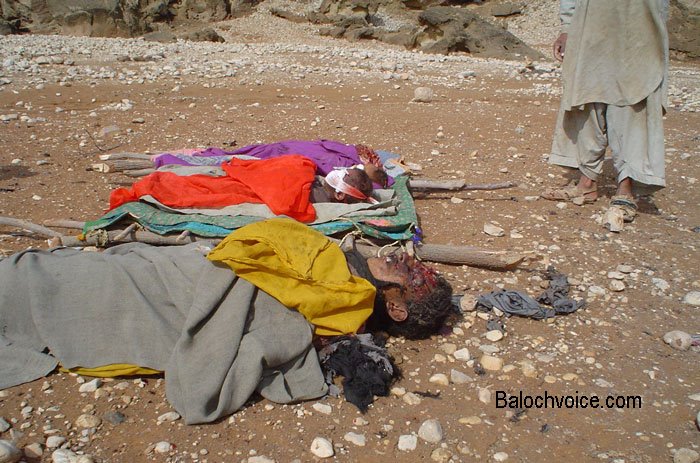
Here is a picture of a Pakistani mother and her two infant children recently slaughtered by Cobra helicopter gunships provided to Musharraf by the US. This photo and several other similar pictures are currently circulating on the web and are being viewed with feelings of profound horror and distress by scores of ordinary Pakistani citizens.

I have been told by a Baloch acquaintance that the pictures are undeniably authentic – for one the rather frayed sandals worn by one of the men standing by the ravaged corpses are typical Baloch tribesmen footwear.

Collateral damage is a loathsome word made-up by the US military to gloss over civilian deaths in countries it picks to invade. This word becomes even more repulsive when it applies to the massacre of civilians by their own national army, as is apparently now taking place in the Balochistan province of Pakistan.

Rather than admit to their misdeeds, the Commando General and his flunkies have resorted to a pathetic game of semantics. These shameful individuals are now parroting the same specially chosen stock phrase:

General Musharraf - ‘made it clear no military operation was going on in Balochistan’.
Director General ISPR Maj Gen Shaukat Sultan - ‘no military operation is going on in Balochistan’.

The same idiotic mantra of ‘no military operation’ has also been publicly repeated ad nauseum by political poltroons such as the likes of
Shaukat Aziz, Aftab Sherpao, Sher Afgan Niazi and Sheikh Rashid.

According to this week’s
Newsweek magazine:


Thousands of paramilitary and Army troops, backed by Air Force jets and helicopter gunships, recently launched a major offensive. Baloch nationalist leaders allege that hundreds of people, including women and children, were killed in bombardments in Kohlu district.
I wish someone would ask these reality-challenged morons a simple question: How can the obvious abundant use of high-tech night vision capable, TOW-missile carrying helicopter gunships and Air Force jet fighters not be termed a military operation?

And so what if in bureaucratese the Frontier Constabulary uniformed militiamen are not officially part of the army? Not only are the FC militiamen recruited and controlled by the Ministry of Defence, but these uniformed troops are also commanded by serving army officers under the ultimate command of General Musharraf.

(And by the by, since when were these humdrum militiamen given direct control over the use of sophisticated helicopter gunships, Air Force jet fighters and heavy artillery, as are now being used in Balochistan? )

______________________________________________________


Yesterday I read a local news report on the Internet (which all of a sudden seems to have disappeared – surprise, surprise!). This news report stated that when radio’s Voice of America correspondent Murtaza Solangi tried to contact Akbar Bugti on his satellite phone the call was answered by a person who reported that everyone in Dera Bugti was sheltering in trenches as the town was being bombarded by artillery and mortar rounds. Then the man from Dera Bugti apparently lifted his telephone receiver above the trench and the radio listeners of VOA were suddenly provided with live graphic sounds of heavy bombardment.

And so, as I said, this report suddenly vanished when I attempted today to link it to this blog. To compound this bizarre reality today I read that the Human Rights Commission of Pakistan’s (HRCP) chairman Asma Jahangir was fired upon as she attempted to reach Dera Bugti to find out the on-the-ground reality. This is what the
Daily Times had to say:


According to the government, Ms Jahangir’s car was targeted by ‘miscreants’ and was escorted to safety by security forces. Ms Jahangir denied this vehemently. She said Afrasiab Khattak, former HRCP chairman, left Multan for Sui on Sunday. They were accompanied by journalists in a separate car. The cars were photographed from Multan to DG Khan by what appeared to be security personnel, Ms. Jahangir said. As the convoy approached the Balochistan border, a man pointed a torch at HRCP officials’ car and then two gunmen sprayed bullets around the car, not actually hitting it. The driver reversed the car. The journalists’ car was untouched. An FC unit is stationed half a kilometre from the site but paramilitary soldiers did not help the HRCP team.
Subsequently a shocked General Secretary of the HRCP Iqbal Haider told the Press:

That instead of being provided security, the [HRCP] delegation came under fire at the checkpost manned by the law enforcing agencies.
Terming it as unprovoked, Haider said the authorities had no legal or constitutional right to fire at peaceful citizens or to prevent them from visiting Kohlu and Dera Bugti areas.
So website news reports conveniently vanish and fact finders approaching Dera Bugti get warning shots to dissuade them from visiting. Obviously something is extremely rotten in current state of Pakistan – the smell of Khaki rot has suddenly become all too pervasive.

Sadly to date the generals of the Pakistan army have failed in every war (1948, 1965, 1971 and 1999). Their only success so far has been at the expense of Pakistani civilian lives – East Pakistan (1971) and Balochistan in 1973 – 76. It looks like our ill-fated history is being repeated by Musharraf yet again.

Killing of innocent men, women and children in Pakistan is a crime punishable by the death penalty. It is high time Musharraf and his goons were reminded that laws are meant apply to all in a country and a khaki uniform does not grant anyone any immunity.


_______________________________________________________


Dear readers

If you truly care about Pakistan then please make others aware of what is currently happening in our dear country.