Friday, January 27, 2006

WPost Accuses Musharraf of Behaving Like a Prostitute?


A Washington Post editorial recently lambasted Musharraf by calling him a “meretricious military ruler”.

Not being familiar with the word, I had to look it up in my dictionary.

The Chambers Dictionary (1983) defines the adjective meretricious as: of the nature of harlotry; characteristic or worthy of a harlot; flashy;
gaudy
Apparently the root of the word comes from Latin: meretrix : a harlot – which in turn is derived from merere : to earn.

But then the Oxford Dictionary (1999) comes somewhat to Musharraf’s rescue. It defines meretricious: showily but falsely attractive. And, declares the meaning characteristic of a prostitute to be archaic.

Anyway calling Musharraf meretricious was just one among many disparaging criticisms the WP hurled at the general. Read it for yourselves…

_____________________________________________________

WP Editorial : The War in Pakistan (Wednesday, January 25, 2006; Page A18)


SHORTLY AFTER Sept. 11, 2001, President Bush famously declared that other countries must choose between supporting the United States and supporting terrorism, and that those that harbored al Qaeda would be treated as the enemy. In the years since, he has refrained from applying that tough principle in practice -- which is lucky for Pakistan's president, Gen. Pervez Musharraf. Ever since the war on terrorism began, this meretricious military ruler has tried to be counted as a U.S. ally while avoiding an all-out campaign against the Islamic extremists in his country, who almost surely include Osama bin Laden and his top deputies. Despite mounting costs in American lives and resources, he has gotten away with it.

Gen. Musharraf and his aides, such as Prime Minister Shaukat Aziz, boast that Pakistan has arrested hundreds of al Qaeda militants and deployed tens of thousands of troops in the border region near Afghanistan. Yet Gen. Musharraf has never directed his forces against the Pashtun Taliban militants who use Pakistan as a base to wage war against American and Afghan forces across the border. He has never dismantled the Islamic extremist groups that carry out terrorist attacks against India. He has never cleaned up the Islamic madrassas that serve as a breeding ground for suicide bombers. He has pardoned and protected the greatest criminal proliferator of nuclear weapons technology in history, A.Q. Khan, who aided Libya, North Korea and Iran. And he has broken promises to give up his military office or return Pakistan to democracy.

The consequences of this record are that al Qaeda has continued to operate from Pakistan, while U.S. and allied troops have been unable to pacify southern Afghanistan. More than 125 American soldiers have been killed there in the past year, many of them by militants crossing the border. Osama bin Laden is apparently secure enough to have released an audiotape last week threatening more attacks inside the United States.

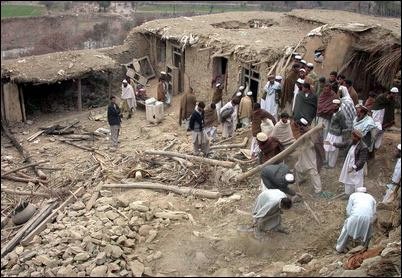
The Bush administration is still providing Gen. Musharraf $600 million in annual military and economic aid and treating him as a major ally. But in the absence of effective Pakistani action, it has also stepped up its own clandestine operations in the border areas where al Qaeda and its allies are based. At least three times in the past year, drone aircraft armed with missiles have attacked terrorist targets; most recently, a strike on a Pakistani village this month killed at least 13 people, several important al Qaeda operatives possibly among them.

In keeping with his double game, Gen. Musharraf's government publicly criticized the latest attack even though his intelligence service reportedly cooperated with it. Now he and Mr. Aziz, who met with Mr. Bush yesterday, are saying U.S. forces should carry out no more such attacks without Pakistani agreement. We'll assume that's more of their bluster. Even if it is not, Mr. Bush should ignore it. Gen. Musharraf perhaps cannot be forced to side decisively with the United States against the terrorists, as the administration once hoped -- though much more could be done to raise the price of his feckless cooperation. But Mr. Bush must take every available measure to eliminate the al Qaeda and Taliban operations in Pakistan. If targets can be located, they should be attacked -- with or without Gen. Musharraf's cooperation.


______________________________________________________

Please note WP’s last suggestion, which basically calls for the US to target Al Qaeda and Taliban wherever they may be found in Pakistan regardless of what Musharraf’s views may be on the subject.

Since our chest-thumping Commando-in-Chief is now of little help, I’m seriously thinking of distributing downloaded pictures of all the wanted Al Qaeda men among the chowkidars in my locality. If by some remote chance a suspiciously gaunt, tall and bearded Arab-looking character is spotted nearby, then I am decamping from the neighbourhood, with my family, as fast as practicably possible. There is no telling when the Yanks will unleash their next lot of Hell Fire missiles on us poor unsuspecting Pakistanis.


Islamabad’s Cloud Cuckoo Land


If one ignores the official claptrap from Islamabad – delivered by the likes of the ISPR, Sheikh Rashid and Aftab Sherpao – the picture in Waziristan looks distinctly unhealthy.

A couple of days ago it was reported in the US press (
Christian Science Monitor):
There is a growing perception that the Army, having
seen its strategies fail, has largely retreated to its barracks. "It has become more of a reactive force, mostly hitting when fired upon," says General Masood. The region remains closed to foreign journalists. But local journalists describe Army personnel as captives in their own barracks, unable to leave for fear of being shot at or kidnapped.
While the Army and its political flunkies will continue to deny these realities, one just has to look at the situation in Miranshah, the ‘urban’ capital of Waziristan district.

On the evening of 8 December, as
Dawn reported, members of the Taliban ‘summarily executed' two members from a rival group, beheaded them, publicly dragged the headless bodies on the road behind their pickup trucks before stringing the corpses up on power poles in the heart of Miranshah.

While all this was taking place there was no apparent sign of any ‘officialdom’ at that time and on the days that followed. The dead bodies were subsequently removed from the power poles 'as they were causing a traffic jam' and simply flung into some vacant space where they ‘remained unattended’. In the meanwhile, the Taliban continued with their overt ‘search operation’ for their rival gang members, raiding nearby villages and openly patrolling the roads around Miranshah.

Hmmm?

Whoever insists that Waziristan is under control is currently divorced from reality, and this must certainly include the ISPR chief Maj. Gen. Shaukat Sultan, who routinely insists that all is well with Waziristan.


Here are some excerpts from a recent
New York Times report:

  • The tribal areas are off limits to foreign journalists, but the Pakistani officials, and former residents who did not want to be identified for fear of retribution, said the militants - who call themselves Taliban - now dispensed their own justice, ran their own private jails, robbed banks, shelled military and civilian government compounds and attacked convoys at will. They are recruiting young men from the local tribes and have gained a hold over the population through a mix of fear and religion, the officials and former residents said.
  • They have embarked on a disruptive campaign of terrorism, particularly in North and South Waziristan: in the last year, 108 pro-government tribal elders, 4 or 5 government officials, informers and even 2 local journalists, have been assassinated by militants, local journalists say.
  • Qaeda operatives are the driving force behind the local militants and are influencing their tactics, the officials said.
  • Pakistan's military has become more cautious about emerging from its bases in the area and the civilian administration is so hamstrung that the senior government representative in South Waziristan does not even live in the district.
  • "We run a government on paper, but not on the ground," said one government official who has worked in North and South Waziristan, which have seen some of the heaviest combat of the past two years.
  • "The situation is going from bad to worse," the official said. "No one can raise their voice against the Taliban." Armed local militants come and go freely and have even opened offices in the main bazaar of Wana, in South Waziristan, from which they recruit new followers from the large, illiterate and unemployed youth of the area, one former resident said, asking not to be named for fear of retribution from the militants.
Ironically as Waziristan spins out of control the military equipment given to the Pakistan Army – in particular the TOW missile-equipped Cobra helicopter gunships - to deal with the Al Qaeda/Taliban threat is instead being used in Balochistan.

Your Blogger wouldn’t be surprised if the US doesn’t get mightly cheesed off at some stage – that is, if it isn’t already.


Thursday, January 26, 2006

In Memory of a Worthy Man


This morning Khan Abdul Wali Khan died. Many of the current younger generation probably know less than little about the man. In remembrance of this fine and upright individual it is only appropriate that your Blogger (who is non-Pukhtoon, by the way) provides you with an honest anecdote which might help reveal something about the person that Wali Khan truly was.

___________________________________________

Many years ago there were a bunch of young men from Downunder who travelled the length and breadth of Pakistan, meeting people of all ilk. It was their unfortunate experience that they ended up meeting with a shade too many politicians and business, social and military grandees wherever they went – for example the likes of ‘Chandi’ Abida Hussain in Lahore and Governor Fazle Haq in Peshawar. Because of their Pakistani host they ended up unexpectedly as guests of Khan Abdul Wali Khan for afternoon tea at his house at Charsada.

At Walibagh the discussions at tea revolved around growing roses, the sights of Eastern Europe and finding a decent meal in London, among other things. As they headed back to their accommodation the Downunder lot came across graffiti written in English painted on many walls in central Peshawar, most of these scrawls in those days simply read ‘Free Wali Khan’. The coincidence suddenly dawned upon one of them who asked, ‘We just met a Wali Khan. They couldn’t be referring to him, surely could they?’ When the answer was affirmative and they were told that Wali Khan had recently been the Leader of the Opposition, they appeared visibly dumfounded.

When asked about the cause of their all too obvious amazement, their collective answer was delivered with traditional Downunder bluntness, “The Pakistani big shots we have met so far has been so bloody full of themselves that they can’t talk about anything other than about how great and marvelous they bloody are. Today we met with a man who was actually interested in who we were, what we did and what our thoughts were. He never even bothered to let us know how important he might be politically or otherwise. In comparison with that hollow mob, Wali Khan seems to an amazing man.”

______________________________________________________

And so we now bid farewell to a remarkable individual. A man who believed in principles and lacked completely the sin of arrogance, a man who had the courage to face the worst without fear and never bowed his head or accepted the corrupt crumbs from those prepared to make him infinitely wealthy.

God Bless him. Years ago the Establishment deemed him a traitor but little did these self-righteous haramis bother to realise that Wali Khan was one of the very few selfless and well-meaning leaders this country ever had.


Fraud Wins Again!


Some days ago a young girl was kidnapped in Karachi, she was purportedly the step-daughter of someone with high influence in the Sindh Cabinet. Fortunately, the girl was soon recovered from Larkana, where it appears she had been held captive in a house of a supposed high ranking government officer.

Soon the law enforcement authorities discovered that this crime (as well as several other recent cases of kidnapping) had all involved movement in vehicles with dark tinted windows and official sounding sirens. This then led to an active police campaign to vigorously implement the law against vehicles with black-tinted windows, blue flashing lights and fancy number plates.

Karachi police officers rather bravely announced that “The drive is being carried out without any discrimination and no one violating the rules would not be spared.”

And so, as yesterday’s
Dawn reported:

Sons and relatives of many influential people spent Saturday night in the lockups of various police stations in Clifton Town and got bail on Sunday morning. They were held for having tinted glasses, flashing or blue headlights, or fancy number plates in their respective vehicles.

The drive is being carried out across the city and motorists were held in various localities for violating the traffic rules. However, most of the motorists, who happened to be siblings of some influential people, were held in Clifton town.The Clifton town police registered a total number of 186 FIRs overnight and put behind bars the siblings of influential people along with their vehicles including son of an adviser to the prime minister, son of an EDO Hub, nephew of the Inspector-General of Police, and relatives of provincial and federal ministers besides the siblings of officers in health and other departments.
Was this a sign of a brave new world?

Sadly no. The campaign came to a crashing halt when the police stopped one Aamir Liaquat, Minister of State for Religious Affairs, TV’s ‘Aalim on Line’ and bogus BA, MA and PhD degree holder. According to today’s
Dawn:

Police said that Dr Amir Liaquat’s car was intercepted on Khayaban-i-Shamsheer in Defence Housing Authority near Defence Stadium. Witnesses said that the police had stopped the car as it had tinted glasses and a number plate other than the one issued by the government. Dr Liaquat objected to police behaviour and made a call to Sindh home minister, who rushed to the spot. The police officials were admonished for intercepting the state minister’s car. After the home minister’s intervention, Dr Liaquat was let off. The police did not register any case against him.
Subsequently a senior police officer stutteringly tried to exonerate Aamir Liaquat by insisting that his had car ‘zero- level’ tinted windows which were permissible under the law. There is tinted glass and plain glass, pray tell us what sort of animal is ‘zero-level tint’?

Anyhow it goes to show that the Aalim Online has more influence than the ordinary humdrum ministers or former prime ministers (Zafarullah Jamali’s son had reportedly been nabbed in Karachi for the same offence a few days earlier).

It would make for great sense if the great Aalim went on to explain to his fans, on his next show, how under Islam the law cannot be equally applied to all; specials exemptions will always exist for gifted Aalims such as himself.

___________________________________________________

Seeing as we are already on the issue of Aamir Liaquat, your Blogger recently received staunch criticism from some readers for purportedly denigrating the great man by referring to him as Jahil Online. From now on, as I intend to follow facts strictly to the line, I do apologize for having used incorrect terminology - from henceforth I shall refer to this person only as Fraud Online.

Here is what the
South Asia Tribune had to say about Fraud Online's so-called 'university' degrees.

Dr Aamir did not have a graduate degree in 2002 and according to the investigation he approached a web site in Spain, The Trinity College & University, which boasts about providing Bachelors, Masters or even Doctorate degrees, without attending any class or college. “Everything by Email” the web site of the College says right on top with the big slogan: “Get your degree today.” Click to View Web site

Dr Aamir bought his “Bachelor of Arts in Islamic Studies” degree (Serial No: P-2002227 Dated March 17, 1995), got his “Master of Arts in Islamic Studies” degree (No: P-2002341 Dated March15, 2002) and his “Doctor of Philosophy in Islamic Studies” degree (No: P-2002528 Dated April 5, 2002). In what may be a world record worthy of the Guinness Book of Records. He got his Doctorate in just three weeks after his Master's degree, if the documents are to be believed.

The UK Observer newspaper has something to say about this so-called university as well:

When it arrives, the literature for the self-styled Trinity College and University, based at Fuengirola in Spain, gets quickly to the point. 'We provide a unique service by helping people who have not had the advantage of a college education by converting all your prior learning, academic and qualified experience into a "non-traditional" degree,' it says.

A degree will help you get ahead in the job market, it continues, adding: 'We do not ask you to take time off to study further or sit exams, nor do we have any residency requirements.'

All you have to do is to fill in a form specifying what class of degree you would like and in which subject, then send it off with a cheque for the appropriate fee: £125 for a Bachelor, £150 with honours chucked in; £195 for a Masters; and £295 for a Doctorate. Along with your certificate, you receive 'any study material you may have ordered' it adds, almost as an afterthought.

And, it was reported in UK’s
Mail on Sunday newspaper that the so-called Vice-Chancellor of Trinity College and University is one 'Dr' Anthony Peel-Bayley, a convicted conman who has been selling fake degrees for years.

I wonder what Fraud Online would have to say about this?


Tuesday, January 24, 2006

UK Times on Pakistan Army's 'Summary Executions'


Your Blogger just came across this story in today's UK Times, together with a brief piece in the Financial Times (links are provided)

I'm glad to see that the heat is slowly but surely building up on Musharraf's latest misdeed.

______________________________________________________________________

The Times
January 24, 2006

Asia
Captured rebel tribesmen 'shot on the spot' by army

FROM ZAHID HUSSAIN IN DERA BUGTI

THE Pakistani Army has been accused of carrying out summary executions as fighting intensifies between rebel tribesmen and security forces in the southwestern province of Baluchistan.

Weekend clashes in the dusty town of Dera Bugti, a centre of the rebellion, left nine tribesmen dead and four soldiers injured. The nationalist rebels, who are fighting for greater autonomy, attacked an army base, a telephone exchange and government offices. The sides exchanged rockets and mortar fire.

The Pakistani military, which is confronting al-Qaeda-backed Islamic militants in the North West Frontier province, is having to commit increasing resources against the separatist movement in Baluchistan, where the provincial capital, Quetta, is under tight security.

“There were alarming accounts of summary executions, some allegedly carried out by paramilitary forces,” the Human Rights Commission of Pakistan (HRCP) said in a report last weekend.

It also said that there was evidence that indiscriminate bombing by the security forces had resulted in deaths and injuries among the civilian population.

Asma Jehangir, the chairman of the group, said that there was a warlike situation in the province. “The HRCP team found widespread instances of disappearance, of torture inflicted on people held in custody and on those fleeing from their houses,” Ms Jehangir, a former UN human rights rapporteur, said.

The strategic region, which borders Afghanistan and Iran, is the largest and most impoverished in Pakistan. It is sparsely populated but rich in mineral resources, and it supplies 50 per cent of the country’s natural gas.

Baluchi nationalists, who demand control over their natural resources, have led four insurgencies — in 1948, 1958-59, 1962-63 and 1973-77 — which were brutally suppressed. There have been sporadic clashes in the past two years, but the situation flared last month after the rebels launched a rocket attack during President Musharraf’s visit to an army garrison in Kohlu district.

The rebels also hit an army helicopter that was carrying senior officers. A shadowy militant group calling itself the Baluchistan Liberation Army (BLA) claimed responsibility for the attacks on the government forces and installations.

The BLA originally drew on veterans of the insurrection of the 1970s, but its ranks have been joined by educated young people. One of its leaders is Akbar Khan, the chief of the Bugti tribe who, in the 1950s, was briefly the Pakistani Defence Minister and later became governor of the province. When I visited him recently, the charismatic, British-educated septuagenarian was presiding over his followers from a bullet-ridden fort in the dusty town that bears the name of his tribe.

He was surrounded by heavily armed tribesmen with flowing beards and huge turbans. Some had taken positions in the bunkers around the fort. Akbar Khan, whose grandfather, Shahbaz Khan, was a British knight, has accused the Pakistani Government of colonising Baluchistan.

He said: “We are fighting for the control of our national wealth and for political rights. It is a war now.”
He is understood to have moved since to a mountain hideout,
where he is leading the guerrilla war.

Down the road Karim Baksh, a thin-framed man with a cropped beard, was leading another group of tribal guerrillas. They had dug in under a huge rock, only a few miles from a Pakistani Government paramilitary post. Machinegun fire echoed in the distance.

“Let them come here,” Mr Baksh said with a laugh as he stroked his Kalashnikov. “They will not be able to go back alive.”

His fighters, who claimed to be members of the BLA, appeared to be well trained and were armed with machineguns and rocket launchers. A radio operator was receiving information regarding the movement of government troops.

“Our men are spread all over,” Mr Baksh said, pointing towards the parched hills of Baluchistan.

ROCKY BUT RICH

  • Forms 44 per cent of Pakistan’s land mass; has a 480-mile (770km) coastline
  • Economically rich in minerals and gas deposits
  • Consists of vast rocky desert with extremes of climate and very low rainfall
  • Baluchi tribes live in Iran, Afghanistan, and Pakistan and can speak a form of Persian; today about half live in Baluchistan territory
  • Five million people live in Baluchistan

_______________________________________________________________

Financial Times

Human rights violations

Human Rights Commission of Pakistan yesterday accused the government of gross human rights violations in the province of Baluchistan.

Tensions in Baluchistan have mounted in recent months as tribal militants have attacked government facilities and cars, following demands for greater provincial autonomy and control of large gas fields in the province.
The report said up to 85 per cent of the 24,000 residents of Dera Bugti had fled their homes after the town was shelled by government troops.

Farhan Bokhari, Islamabad

_______________________________________________________________


Monday, January 23, 2006

A Ruthless Voice From the Past


Sadly many Pakistanis continue to be fooled by the propagandists from Islamabad.

Thirty-five years ago we lost more than half our population thanks to the widespread belief that most East Pakistanis were unpatriotic miscreants. Few bothered to consider the fact that the malaise lay with the rulers and not with the people.

And so, as history repeats itself, we now have Musharraf and his gang repeatedly warning us about the unpatriotic miscreants of Balochistan. According to them the state is now under attack by heavily armed tribesmen following the tyrannical orders of their sardars.

Here is a pertinent quote from the Nazi Reich Marshal, and heir-apparent to Hitler, who asserted:

Voice or no voice, the people can always be brought to the bidding of the leaders. That is easy. All you have to do is tell them they are being attacked, and denounce the peacemakers for lack of patriotism and exposing the country to danger. It works the same in any country.


Hermann Goering


Quote taken from, Nuremberg Diary, Gustave Gilbert, Farrar, Straus & Co., 1947, p. 278.
________________________________________________________


The Egotistical Lightweight vs.The Rape Victim


A Reuters Report says that Pakistani diplomats pressurised the UN to cancel Mukhtar Mia’s interview planned to be held at the UN, so that it didn’t upstage Shaukat Aziz’s visit to the UN scheduled for the same day.

Last year Shaukat Aziz had to postpone his trip to Washington because it closely followed Indian PM Manmohan Singh’s triumphant visit to the US capital, where not only was Singh accorded much time at the White House but was given the distinction of addressing a Joint Session of the US Congress.

I am sure it is extremely difficult for Aziz to accept the fact that no one in Pakistan, perhaps with the exception of his family and close friends, takes his position as ‘prime minister’ particularly seriously. In all likelihood, adding to this prevailing pain is the fact that he is regarded in Washington as no more than Musharraf’s ‘democratic’ flunkey. In other words, Aziz is probably only too well aware that whatever little fanfare he gets in the US capital is just a result of an insincere and role-playing ‘regard’ that the US has to officially show for Pakistan’s so-called ‘democracy’.


Not surprisingly Aziz’s already battered ego can only take so much. The idea of another international humiliation was probably more than his mind could bear; so Mukhtar Mia’s UN interview simply just had to be nixed.

While Aziz has lamely tried to feign ignorance on the rushed cancellation of Mukhtar Mai’s interview ("I have no idea," he said. "I have no idea how the [UN] functions."), your Blogger doesn’t believe a word he said on this occasion, nor, as a matter fact, has he believed many a thing Aziz has uttered on numerous past occasions.
_________________________________________________________

Anyhow here is the Reuters report as published in the
Boston Globe
UNITED NATIONS (Reuters) - The United Nations, under pressure from Pakistani diplomats, barred an interview with a rape victim from Pakistan while the country's prime minister was at U.N. headquarters, her sponsors said on Friday.

Prime Minister Shaukat Aziz told a news conference he was unaware of the controversy and had supported the campaign waged by Mukhtaran Mai.

"I have no idea," he said. "I have no idea how the place functions."

Mai, a 33-year old peasant woman was gang-raped in 2002 on orders of a local council for an offense committed by her brother and forced to walk home nearly naked before a jeering crowd. She prosecuted her attackers and became a women's rights leader.

The New York-based charity Virtue Foundation had set up several interviews with Mai at the United Nations on Friday, the main one being conducted by CNN.

"Faced with pressure from Pakistan's mission to the United Nations, which asked them to cancel the event, it was canceled at 8 p.m. last night," said Joseph Salim, founder and executive director of the foundation.

U.N. sources said Pakistani envoys did not want to detract attention from the prime minister's visit. Pakistani diplomats were not immediately available for comment.

…Pakistani President Pervez Musharraf was not always supportive of Mai. Last year, he banned her from traveling to the United States so she would not "malign Pakistan" and said getting raped had become a "money-making" concern. The government relented after international protests.

__________________________________________________

An Addendum

From the US National Review:

SHAMEFUL, CRAVENLY U.N. VS. “THE BRAVEST WOMAN ON EARTH"

UNITED NATIONS, Jan. 20 - Mukhtar Mai, the Pakistani woman whose defiant response to being gang-raped by order of a tribal court brought her worldwide attention, was denied a chance to speak at the United Nations on Friday after Pakistan protested that it was the same day the country's prime minister was visiting.

Ms. Mai had long been scheduled to make an appearance called "An Interview With Mukhtar Mai: The Bravest Woman on Earth" in the United Nations television studios, sponsored by the office for nongovernmental organizations, the Virtue Foundation and the Asian-American Network Against Abuse of Human Rights.

But on Thursday night the organizers were informed that the program would have to be postponed because of Pakistan's objections.

Ms. Mai is leaving New York on Saturday so the effect was to cancel her appearance.

__________________________________________________


Sunday, January 22, 2006

Human Rights Team Confirms Military Brutality in Balochistan


As was widely reported, a Human Rights Commission of Pakistan (HRCP) team travelled to Quetta and Sibi (December 26-28, 2005) and to Dera Bugti (January 8-10, 2006) on fact-finding missions to ascertain the true reality of the Balochistan crisis.

A fortnight ago as the HRCP team reached the border of Balochistan near Sui, its Chairperson Asma Jahangir’s vehicle was shot at by suspected security agencies personnel. The aim of the attack, it is widely believed, was to thwart the HRCP team from visiting the area and discovering the falsehood of the military regime’s claims.

Yesterday the HRCP finally released its long-awaited report of its findings. Here are some excerpts, as reported in various newspapers.
_____________________________________________________

The Daily Times
Paramilitary forces are torturing and killing the Baloch, says HRCP
  • That the coercive military operation in Dera Bugti, Sui and Kohlu started on December 17, 2005, still continued and the human rights situation in the province had deteriorated to an alarming level.
  • Residents in areas affected by the violence gave evidence that helicopter gunships and fighter jets were used to bombard Dera Bugti. They complained that their children had had serious mental disorders due to the fear of violence.
  • The HRCP claimed to have received evidence that action by security personnel had led to many deaths and injuries among the civilian population. It said the Baloch had been subjected to indiscriminate bombings and there were many cases in which people had ‘disappeared’
  • HRCP said the most disturbing account was the disappearance of 18 labour union leaders of Pakistan Petroleum Limited (PPL) in December 2005 while they were in Karachi to negotiate various issues with the PPL management. It said the HRCP convoy had been shot at near Kashmore while it was on its way to Dera Bugti. However, the authorities did not register an FIR despite a formal application by HRCP.
  • The report and a visual documentary presented by the HRCP showed bullet-riddled bodies and buildings, armoured personnel carriers (APCs), military pickets, remains of rocket launchers and insecure and frightened people.

The News
HRCP reports rights abuses in Balochistan

  • The Human Rights Commission of Pakistan on Sunday accused President Pervez Musharraf’s military-led government of "gross human rights violations" in Balochistan, where it said a "war-like situation" prevailed.
  • The HRCP also rejected government claims that it was not using regular armed forces in a crackdown in the province launched last month after rocket attacks by tribal militants battling for greater autonomy and control of natural gas fields.
  • The group said it had "received evidence that action by armed forces had led to deaths and injuries among civilians" and that "populations had also been subjected to indiscriminate bombing".
  • The HRCP report said up to 85 per cent the 22,000-26,000 inhabitants of Dera Bugti had fled their homes after the town was repeatedly hit by shelling by paramilitary forces. "There were alarming accounts of summary executions, some allegedly carried out by paramilitary forces. The HRCP received credible evidence that showed such killings had taken place," it said.
  • "Across Balochistan, the HRCP team found widespread instances of ‘disappearance’, of torture inflicted on people held in custody, and on those fleeing from their houses," it added.
  • "The security forces, as well as the decision-makers, have remained completely unaccountable for the gross human rights violations in the province, including responsibility for the internally displaced people," the report said.

Dawn
HRCP seeks ceasefire, talks on Balochistan

  • Ms Jehangir challenged the government claim of the ongoing ‘casualty-less’ operation and said the HRCP team found that people were being forced out of Sui and 85 per cent population had fled the Dera Bugti town due to fear of rocket and air attacks by armed forces.
  • In its report, the HRCP’s fact-finding mission has found gross violations of human rights by the Frontier Constabulary in the Bugti and Marri areas and ‘seeds of inter-provincial mistrust and enmity being sown by the FC through propaganda.’
  • The report has recorded repeated occurrence of extrajudicial killings, arrests, arbitrary detentions, torture and violations of human rights and freedom of the press in Balochistan.
  • “The HRCP received evidence that action by armed forces has led to deaths and injuries among civilians, including women and children,” Ms Jehangir said. There was evidence of attacks conducted by fighter jets, she added.
  • She said the HRCP team, including herself and Afrasiab Khattak, was fired upon by ‘unknown persons’ near Kashmore. Several bullets were fired in the direction of the team’s car for five minutes.
  • The HRCP chairperson lamented that first the Rojhan DSP did not register their complaint and later the FC people in the Quetta Press Club forced journalists to report a statement allegedly issued by the Balochistan Liberation Army, claiming responsibility for the attack.
  • “The FC has left its job and is serving as a propaganda machine sowing seeds of ethnic disharmony,” she said.
  • She said almost every journalist who met the HRCP team complained of threats they received from intelligence agencies. A few of them said they had been picked up by the agencies and then released.
  • The report reveals information about the children and women killed in the Dec 17 operation in the Marri areas of Jabbar and Pekal. According to it, 12 women and children were killed in Jabbar and 22 injured. Nine women and children were killed in Pekal. The bodies of the victims were never brought to hospitals and those injured could not travel out of fear.

_____________________________________________________

Having been unable, despite draconian attempts, to prevent the truth from being revealed the Musahrraf regime has been exposed for what it is.

I can therefore hardly blame a US magazine from including him on its list of ‘The World’s Worst Dictators’.

The latest issue of the Parade magazine describes our Commando-in-Control as:

'Dictator No 17' Pervez Musharraf, Pakistan - Age 62. - In power since 1999.
General Pervez Musharraf seized power in a military coup that overthrew an elected government. He appointed himself president of Pakistan in 2001 and then attempted to legitimize his rule by staging an election in 2002. However, the election did not come close to meeting international standards. Musharraf agreed to step down as head of the military but then changed his mind, claiming that the nation needed to unify its political and military elements and that he could provide this unity. He justified his decision by stating, “I think the country is more important than democracy.” Prior to September 11, 2001, Musharraf was an ardent supporter of Afghanistan’s Taliban regime.

I rest my case!

_______________________________________________________

The interesting picture above is taken from today’s Dawn. It is subtitled:
DERA BUGTI - January 22, 2006: Armed tribesmen guard their leader Nawab Akbar Bugti who has taken shelter in a cave (bottom left) in a mountainous area of Dera Bugti on Sunday. Nawab Bugti fled his hometown after troops launched an operation here last month.


Saturday, January 21, 2006

Balochistan Crisis (contd.)


As a rule your Blogger prefers not use Indian news material. Why? Simply to avoid the customary and rather noxious finger pointing that goes on in Pakistan the moment anything ‘Indian’ is involved.

The truth is that in India - just as in Pakistan - there are a large number erudite and rational people who write without recourse to ingrained conflict-ridden ideologies.

I read the following article today on OutlookIndia.Com and can’t fault it for any bias other than the fact it lays bare the Musharraf regime’s falsehoods -but then my Blog has been attempting to do the same. And so, I believe it is an article worth sharing.


____________________________________________________

I suppose that Bloggers - being mostly ordinary and normal people - need a cause to personally motivate them to keep on writing. My cause has always been to look at my beloved country with unbiased eyes and report what I percieve are the current realities, 'warts and all'. After all doctors can only treat patients once they work out what is ailing them. Similarly, we need to discover our national frailties before we can try and remedy them.

Our military regime might call it 'washing dirty laundry in public'. My response is to try and work out how the clothes got dirty in the first place, and why the bloody hell no one is doing anything about it. To me hiding ugliness under the cover of 'patriotism' can only be a scoundrel's trick.

Right now one of my pet causes is the tragedy that is being currently inflicted on my fellow Pakistanis in Balochistan. The regime is trying to confuse everyone by resorting to non-stop propaganda and by attempting to clampdown on any independent information emanating from the beleaguered province.

Undoubtedly you will be hearing more about Balochistan from me in the upcoming days.

In the meantime read on:
___________________________________________

A Tragedy Unfolds
As the world pays virtually no attention, the Baloch insurgency is an indication of the larger malaise that afflicts Pakistan, a crisis which opposition leader Raza Rabbani aptly calls "a crisis of the federation".

KANCHAN LAKSHMAN

"A very great tragedy is unfolding in Balochistan, and sadly the world is not paying attention." - Akbar Bugti


On December 17, 2005, the Pakistani Army and paramilitary launched an operation against the Baloch insurgents in the Kohlu, Dera Bugti, Noshki and Makran Districts, as well as other parts of the Balochistan province. The subsequent and escalating violence, including the indiscriminate bombing and strafing of civilian populations, and repeated and widespread clashes with suspected Baloch insurgents and dissenting tribesmen has led many to describe this as the 'fourth rebellion' in the Province since the creation of Pakistan.

Senator Sanaullah Baloch of the Balochistan National Party - Mengal group (BNA-M) told South Asia Intelligence Review on January 12 that the Pakistan Army and Air Force 'carpet-bombing' from December 18, 2005, had killed over 300 people, mostly women and children. Sources from the Marri and Bugti tribes indicate that intensive bombing and shelling by Helicopter Gunships and heavy artillery are currently continuing in Balochistan. The operations, which initially targeted the Marri tribe in Kohlu District, are now reported to have spread across other parts of the province.

Baloch leaders claim that the 50,000 regular Army troops are currently deployed in Balochistan, in addition to 37,000 personnel of the para-military Frontier Corps (FC). Sources confirm that there has been a significant enhancement of the military presence in the province over the past months, with an addition of at least four thousand FC personnel; another 2,000 Pakistan Rangers redeployed from Sindh and Punjab; and the 29th Infantry Brigade that has been brought in from Zhob to Dera Bugti. Baloch sources claim that the weaponry being used includes helicopter gunships, fighter jets, heavy artillery and missiles.

Nawab Akbar Khan Bugti, chief of the Bugti tribe, told Praveen Swami of Frontline in an exclusive interview that jet aircraft have been strafing and bombing the heights on either side of the Sui and Loti valleys. According to Sanaullah Baloch, moreover, "some dirt bombs and gases have also been used in first phase of bombing." These claims are yet to be corroborated by any independent media or source, since the Press and various independent agencies are being rigorously kept out of Balochistan by the military. Baloch sources, nevertheless, have put up a large number of photographs, lists and details suggesting that the overwhelming majority (Nawab Bugti claims 85 per cent) of those killed have been women and children, and that most of the military actions have targeted civilian settlements, rather than identifiable insurgent groups.


While the intensity of Islamabad's response may have come as a surprise to many outside the region, these are entirely in line with President Pervez Musharraf's earlier proclamations on a 'solution' to the 'Baloch problem'. In early 2005, he had warned the rebels, "Don't push us… It is not the '70s. We will not climb mountains behind them, they will not even know what and from where something has come and hit them." The Baloch leadership, 12 months later, is only shocked at the immediate scale of devastation, but not by the means employed, or the intent of the President.

The province, it merits repetition, is of critical importance to Pakistan, both strategically and otherwise. There are four major cantonments, 59 'mini cantonments', six missile testing ranges and three nuclear testing sites in Balochistan. Pakistan Air Force has six bases and the Navy another three in the troubled province, which is dotted with over 600 military check posts.

Baloch nationalists describe the entire province as a 'mega-cantonment'.


Available information suggests that Kohlu and Dera Bugti Districts are currently completely surrounded by troops. Further, of Balochistan's 28 Districts, the 16 most strategic and important in terms of natural resources are now directly affected by the insurgency, and constitute a security problem for the military regime. Contrary to General Musharraf's position that only three of the 78 tribal chiefs in the province were "troublemakers", the truth is that insurgent attacks have left no part of the province unaffected. There has also been a continuous series of bomb and rocket attacks on gas pipelines, railway tracks, power transmission lines, bridges, and communications infrastructure, as well as on military establishments and governmental facilities and enterprises over the past 12 months, and on December 27, 2005, Interior Minister Aftab Ahmed Khan Sherpao confirmed that there had been "an increase in the momentum of militancy recently".

Official data indicated that 187 bomb blasts, 275 rocket attacks, eight attacks on gas pipelines, 36 attacks on electricity transmission lines and 19 explosions on railway lines occurred in the year 2005. According to open source information monitored by the South Asia Terrorism Portal, at least 182 civilians and 26 security force personnel died in the Province during 2005. However, given Islamabad's understated accounts, the suppression of the Press and erratic reportage from this poorly covered region, the actual numbers could be much higher.

The Human Rights Commission of Pakistan (HRCP) team led by Asma Jahangir, after its visit to Dera Bugti, noted that, "Due to the ongoing armed sorties, around 85 percent of the local population has already left Sui while Nawab Akbar Bugti has also vacated his residence in the town. Sui has in fact been shut off from the outside world since December 17th." Incidentally, on January 8, 2006, the HRCP team came under attack when two unidentified men fired at their vehicles in Sui. The Daily Times noted that the HRCP team was allegedly shot at by "security personnel" to prevent a neutral observer from finding out what was actually going on. The HRCP delegation was also "amazed to note" that the "police have not registered the FIR [First Information Report] of the firing incident on the HRCP vehicle that took place Sunday. Three charges of Kalashnikov fire were unleashed during the attack. It is also intriguing that the Balochistan Liberation Army (BLA) has claimed responsibility, given that the outfit has no quarrel with HRCP."

In addition to the widely dispersed attacks on vital state installations and SFs, two emerging patterns of insurgent attack are of great significance. The first of these is what Federal Interior Minister Sherpao called a deliberate attempt to target "settlers" in Balochistan, some of whom he claimed had been attacked and killed on December 26, 2005. The second is an attack on three launches of the Pakistan Navy at the Fish Harbour in Gwadar on January 7.Amidst all this violence, Islamabad continued to issue denials about any military operation in the troubled province. Thus Federal Minister for Defence, Rao Sikandar Iqbal, stated at Okara, on January 9, 2006, that no military operation was being launched in Balochistan. Strikingly, the Federal Information Minister, Sheikh Rashid Ahmed, noted at Islamabad that the "operation has been wound up in Balochistan", but that SFs would remain in the province and strictly deal with those found involved in breaches of the law. These denials and reluctant admissions have been central to the military regime's attempts at a complete clampdown on information from the province.

Islamabad has been actively blocking information in its efforts to cover up the indiscriminate and disproportionate use of force and the lack of accountability of security agencies operating in Balochistan. Nevertheless, news has been gradually trickling in and the military regime, consequently, struggling to contain the fallout of the world noticing the Baloch insurgency, and Musharraf himself reacted with ferocity when India's External Affairs Ministry urged restraint in the use of force in Balochistan, declaring, "We know who is financing and supplying weapons". Indeed, the military regime and its political proxies have repeatedly sought to lay the blame on the 'hidden hand' and 'external actors' - with India and the US recurring in the statements of the radical Islamist parties - an aspect which very few are willing to accept.

Dismissing allegations of external support, Nawab Bugti declared, "President Musharraf is using his favourite weapon - lies. His Objective is to defame the legitimate demands of the people of Balochistan." Bugti stated, further, "What is the need for us to take anything from anyone? The weapons we are now using flowed into this region when the United States financed the jihad in Afghanistan. It was the Inter-Services Intelligence which distributed them to Afghanistan, Iran, Jammu and Kashmir - and to us in Balochistan." As an editorial in Pakistan's Daily Times rightly noted, "While an exaggerated sense of external threat will not do Pakistan any good, what is happening internally is quite heart-breaking".


Further, the military regime has sought to justify the ongoing action in Balochistan as a reaction to the December 14, 2005, attack on General Musharraf in Kohlu. But this has only deepened the hatred the ordinary Baloch has for Islamabad. As Nawab Bugti recalled, the President had also been attacked in Rawalpindi and Karachi earlier, but no action was taken against the people of these cities.

With the threat of the Mohajir Quami Movement (MQM) to withdraw from the Cabinet having evaporated, at least for now, the small measure of caution that existed within the Musharraf regime has also disappeared. While an MQM pullout would not have affected the Federal Government, the coalition Government in Sindh would have collapsed, and the sectarian violence that long dominated the province may have revived. With Sindh and Balochistan destabilized, an opportunistic escalation in NWFP would be a distinct possibility, and the whole situation in Pakistan could explode beyond the current 'manageable' levels. Such an eventuality has temporarily been averted, with Musharraf buying off the MQM with assurances on the Kalabagh Dam, freeing the military regime to focus its might on repression in Balochistan.

But the Baloch insurgency is an indication of the larger malaise that afflicts Pakistan, a crisis which Opposition leader Raza Rabbani aptly called "a crisis of the federation". The potential for destabilisation in the Sindh and Punjab provinces may currently have been contained, but Musharraf's growing isolation, both within and outside Pakistan, can only compound the multitude of problems faced by his regime, especially as the regime gets increasingly bogged down in the Balochistan quagmire.

____________________________________________________________________


Friday, January 20, 2006

Pakistan Army's Multimillionaires


I came across some fascinating information provided by Dr. Ayesha Siddiqa-Agha, an acknowledged independent expert authority on Pakistani military matters.

______________________________________________________

First, here are some details about Dr. Ayesha Siddiqa-Agha which I’ve manage to collect from the
Internet.

Her expertise: South Asia, military expenditure, arms control, arms procurement.

Her Brief Bio:
She did her doctorate from King's College, London in 1996 and has worked on issues varying from military expenditure, defence decision-making, nuclear deterrence, arms procurement, arms production to civil-military relations in South Asia. She is also a Ford Fellow and more recently Pakistan Scholar at t he Woodrow Wilson International Centre for Scholars.
She began her professional career with the Pakistan navy as the Director of Naval Research, making her the first civilian and woman to work at that position in Pakistan's defence establishment. She writes for various international journals such as: Journal of Asian Affairs, Journal of the European Institute of Asian Studies, Jane's Defence Weekly and the Bulletin of Atomic Scientists. Her major publication to date is the book Pakistan's Arms Procurement and Military Buildup, 1979-99: In Search of a Policy (Palgrave Press, 2001).

The reason for the above blurb on Dr. Ayesha Siddiqa-Agha will soon become apparent; I simply wished to establish her credentials and highlight the fact that she is no intellectual light weight in her specialised field of knowledge.

______________________________________________________

And now for the extracts from an
email interview she gave to DesPardes.com's Editor-in-Chief Irshad Salim, August 2005, about the new book she is currently working on: "Military Inc, The Politics of Military's Economy in Pakistan".

_____________________________________________________________

Question: So what is this book about?

Dr. Siddiqa: This book is about military business operations with a case study of Pakistan.

Question: So what prompted you to write this book?

Dr. Siddiqa: I was a civil servant. During the course of my work I had to deal with numbers of military spending and doing that one slowly realized that a lot was hidden. It is the search for numbers that took me in this direction. The other thing is that it is essential to understand the dynamics of the institution that virtually controls Pakistan's past, present and future.

Question: Ok, so who did you work for as a civil servant?

Dr. Siddiqa: I joined the civil service in 1988 and left in 2001. Served in military accounts, defence audit and later the navy.

Question: Going back to the Pakistan army’s business, what are your findings?

Dr. Siddiqa: Several. First, the military has become predatory engaging in political and economic predation. Second, political predation is not complete without economic predation. Third, military has mutated into a separate class that shares interests with other members of the ruling elite. Finally, because the military protects its vested interests, it leads to alienation of the masses.

Question: When did all this start?

Dr. Siddiqa: It dates back to the early 1950s. The business ventures were started with the establishing of the first foundation called the Fauji Foundation in 1953. This was established with the war veteran's rehabilitation fund of Rs. 18 million.

Question: Why do you consider forming Fauji Foundation a predatory step by the army?

Dr. Siddiqa: Listen you have to understand the concept. A politically strong entity that engages in political predation needs to feel economically or financially autonomous. This completes the picture of predation. The generals thought that they wanted to establish independent means of providing for their welfare and not depending on the civilians like it happened in India. The financial autonomy gradually created the logic for greater interest in political control.

Question: Give me one or two instances when the 1953 move swirled into predation.

Dr. Siddiqa: It started right then with Ayub Khan and his cabal getting agricultural land and establishing independent means for themselves.Look at Ayub Khan. He not only got several squares of agricultural land in Sindh, he also established his sons into business. Look at the entire lot of generals at the moment. A Major General has a legal worth of about Rs. 300 million [Rs. 30 crores]. These are conservative estimates.

Question: Going back to Pakistan army's economic superpower...What percentage of the GDP and GNP is it?

Dr. Siddiqa: This is difficult to calculate but their own estimates are about 4 % of GDP. I would say that their share in private sector assets is about 7-10 percent of private sector assets. This is a large number for any single group.

Question: Can you translate that into crores?

Dr. Siddiqa: 7-10 percent of private sector assets cannot be translated but I can give you another figure: They are worth about Rs. 200 billion. It is just the business. If you put in real estate then we are talking about a Rs 1 trillion plus economy.

Question: You mean Pakistan army's side economy?

Dr. Siddiqa: Yes. This includes real estate, businesses done by subsidiaries, organizations and individuals. You have to understand that this economy is predatory by nature because it does not accept any form of civilian control over it. It is independent in terms of planning, appropriation of funds, etc.

Question: If Pakistan army's assets total Rs 1 trillion can they fund Pakistan’s annual budget wholly or partially if they have to?

Dr. Siddiqa: This would, converting these resources into liquid assets and then it would be possible to pay. A lot of these resources are state resources that could provide for military expenditure and more. It is difficult to say that this money would fund the entire budget. Of course, it can but over what period? These assets were acquired over time and their value should be added to the annual defence budget.

Question: What was the defence budget for the year 2001?

Dr. Siddiqa: 131 billion. If you add these numbers the budget would escalate to over Rs. 400 billion

Question: When you left in 2001 how many generals, etc were there who form the command structure of Pakistan forces?

Dr. Siddiqa: Brigadier and up would be a few hundred.

Question: So if we assume 100 then 100 times 300 million = 30 billion is the legal worth of army's command structure correct?

Dr. Siddiqa: it is more but don't get into these fancy numbers... Plus the higher you go the more pricy you become. A full general is worth Rs 500 million [Rs. 50 crores] plus

Question: How much land does the forces own in each province?

Dr. Siddiqa: Difficult to bifurcate but to give you a taste - they own about 7-9 million acres in Punjab alone

Question: What percentage is it of whole of Punjab?

Dr. Siddiqa: I am still trying to figure this out. It is not an issue of what percentage is this of Punjab but that a major portion of state land is appropriated by one group

Question: What about Sindh?

Dr. Siddiqa: My sense is that it is less in Sindh

Question: Why is that?

Dr. Siddiqa: Most of the land is around the 2 barrages constructed after independence. Because they didn't make new barrages.

Question: What is their modus operandi in getting these lands allotment

Dr. Siddiqa: 10 % of land, according to the 1912 Colonization of Land Act, is allotted to the military

Question: 10% everywhere?

Dr. Siddiqa: Yes it would be everywhere land is found. Colonization of land refers to each land reclaimed due to creation of water channels and other irrigation projects. However, they tend to get more in Punjab

Question: Does India have this act too?

Dr. Siddiqa: No. They got rid of such acts when they did land reforms. Remember India is a state moving towards capitalism. A capitalist state would not create means for institutionalizing feudalism

Question: Are you saying Pakistan army has institutionalized feudalism?

Dr. Siddiqa: I am saying that it is a feudal institution as well

Question: So in that case their interests converge with feudal system correct?

Dr. Siddiqa: Yes

Question: Do you think they resisted land reform along with the feudal?

Dr. Siddiqa: I wouldn't say that they resisted but they had sufficient stakes not to pursue a policy that had a negative impact on their benefits. For example, who buys the land the Faujis sell? The local feudal or the new rural capitalist class that is equally feudal in nature. Why should the officers then try to destroy the class that bails them out financially. After 1999, generals have started to keep their lands

Question: What happened after 1999

Dr. Siddiqa: Since the value of land has gone up, especially after 9/11, generals now keep lands and have turned into absentee land lords

Question: Why did the value of land in Pakistan go up after 9/11

Dr. Siddiqa: Because of the money that started to flow in from Pakistani expatriates plus other Muslim countries

Question: What is their modus operandi in getting these lands allotted to generals individually and to their housing societies collectively?

Dr. Siddiqa: The provincial governments allot the land to the Ministry of Defence who then gives the land to the three services for further dispersal. The land is also given to the Jawans but the quantity is lesser than what is given to the senior officers. Plus, the generals get greater facilities in making the land cultivable.

Question: All this is based on 1912 colonization of land act that India got rid of and Pakistan still has?

Dr. Siddiqa: Yes, but they have done alterations as well. For instance, the act does not say that land meant for operational purpose be appropriated for personal use. It is against the law

Question: Are you saying that land meant for operational purposes are or have been appropriated to the generals for personal use or to the housing societies?

Dr. Siddiqa: Of course. All land in the cities is military land turned into housing colonies

Question: What is the conclusion of your book?

Dr. Siddiqa: Simple: The political leadership in Pakistan has to negotiate the military's gradual withdrawal from the economy if they want democratic institutions to grow

Question: At what value does the army buy land?

Dr. Siddiqa: Between Rs. 30-60 per acre. In some cases they pay more. This refers to the private housing schemes

Question: You mean in Defence Society in Karachi, the army gets land from the provincial govt for 30 to 60 rupees an acre only?

Dr. Siddiqa: There are 2 methods for getting land. All the military land converted for personal use is given at the ridiculous price I quoted. Then there are other schemes where they pay a little more. For instance, the Cantonment Board distributed plots of 500 yards each by appropriating part of the parking lot of the Karachi stadium. Each plot was for about Rs 600,000

Question: What was the fair market value of each plot at that time?

Dr. Siddiqa: One and a half crore

Question: Who got these plots?

Dr. Siddiqa: Generals. The bulk goes to generals. This was done by General Tauqeer Zia. As Chairman Cricket Control Board he authorized himself to return this land that once belonged to the Cantonment Board for further distribution

Question: Any more instances of such land grabbing?

Dr. Siddiqa: The entire Lahore Cantonment was turned into housing schemes. In fact, except for Defence phase I & II (Lahore), the rest of the land does not even belong to the military

Question: How many acres is Lahore Cantonment, if you know?

Dr. Siddiqa: About 8000 to 10,000.

Question: What is its fair market worth now

Dr. Siddiqa: Runs into billions. It should be around Rs. 700 billion

Question: What was the "grabbing price"

Dr. Siddiqa: As I said, Rs. 30-60. This is the rate that officers pay.
______________________________________________________

I recall a journalist telling me that once at a press conference Sardar Attaullah Mengal declared that while the military regime constantly lambasted the Baloch sardars like him for cornering the wealth of Balochistan, he would gladly swap all his assets with those of any general any time, any day.

Now, thanks to Dr Siddiqa, I finally realise what Mengal was getting at.

It soon becomes very obvious that most of us have opted for the wrong career. If a banker friend of mine is right, then the highest paid salaried civilian is one Farooq Bengali, currently heading some Arab bank based in Karachi. Bengali’s annual salary package is rumoured to be in the range of Rs. 3 crores per annum.

Considering it took Farooq Bengali years of much lower salaries to get there and the fact he’ll mostly likely get this kind of salary for eight years at the very most – the maximum he can hope to accumulate in his lifetime is Rs 30 crores. This sum equals, according to Dr Siddiqa, an average major general’s net worth. There must be a few dozen of major generals around at any given time, so there ought to much great scope in getting there; after all there is only job available like Farooq Bengali’s, and he is currently occupying it.

Besides, once Farooq Bengali retires he goes home. The same doesn’t apply to our retired generals; they can become provincial governors, federal ministers, ambassadors, heads of one of the numerous Fauji conglomerates or even be in a position to mismanage the Pakistan Cricket Board. Now that is what a richly rewarding career is all about.


Thursday, January 19, 2006

'The Economist' on Musharraf


The Economist used be one of my favourite magazines until its perchant for conservatism overtook good sense and it became enamoured by George W. Bush

Anyhow, here is what its editorial staff have to say in the magazine's latest issue about the Commando-in-Control and his current travails.
___________________________________________

Musharraf's unhappy new year
Jan 19th 2006 LAHORE From The Economist print edition
Troubles are piling up for Pakistan's president


FOR Pervez Musharraf, Pakistan's president, troubles are coming not as single spies but in battalions. An American rocket attack on January 13th on a remote mountain village in Bajaur, a tribal agency near the border with Afghanistan, provoked angry nation-wide protests. Army action in Baluchistan province against rebellious tribesmen continues to take a toll of soldiers and civilians, and this week anonymous threats prompted foreign aid organisations to suspend operations there. Pakistan-controlled Kashmir, devastated by an earthquake in October, is suffering the misery of a Himalayan winter. Many Pakistanis fear the peace process with India is going nowhere (see article). To cap it all, the president has faced a political rebellion in Sindh province.

The strike in Bajaur was aimed at Ayman al-Zawahiri, the deputy leader of al-Qaeda, mistakenly thought to be there. It is reported to have killed three or four al-Qaeda terrorists—including an explosives expert on the most-wanted list—but also 18 civilians, including women and children. Pakistan has complained, but not over-loudly, given the presumed existence of secret agreements allowing America to wage war on Pakistani soil in certain extreme circumstances.

For the past three years, Pakistan's army has faced an uphill task in this mountainous area. It is infested with heavily armed Taliban and al-Qaeda remnants, bent on making trouble in Afghanistan. Hardly a day goes by without killings by both sides. On January 10th, for instance, seven soldiers and 14 “terrorists” died in clashes in the tribal areas. Locals sympathise with the militants and see the army as an intruder, there at the behest of the Americans. The army commanders say they have killed hundreds of foreign fighters, and frequently claim that the job is almost done. But that is not the case.

As if his troubles in the tribal areas and Baluchistan were not enough, General Musharraf has antagonised Sindh province by promoting the construction of a dam on the Indus river at a place called Kalabagh in Punjab. Sindh, further downstream, is bitterly opposed to the project. Such is the lack of trust that Sindhis suspect Punjabis will “steal” the waters of “their” Indus. They fear that new canals from the dam's reservoir will reduce the flow of water and leave the fertile Indus delta in Sindh vulnerable to the encroachments of the Arabian Sea.
In Sindh, even members of General Musharraf's own ruling coalition are afraid of openly supporting him. In early January the Muttahida Qaumi Movement (MQM), which controls Karachi and the urban areas of Sindh, threatened to quit the Sindh government unless the Kalabagh project was ditched, and military action in Baluchistan halted. It took Pakistan's prime minister, Shaukat Aziz, and General Musharraf an hour each on the phone to placate Altaf Hussain, the MQM's leader, who lives in self-imposed exile in London.

This week, General Musharraf was forced into an embarrassing retreat. Instead of Kalabagh, he said on national television, two other dams would be built first. MQM workers celebrated by dancing on the streets of Karachi. Yet delay in building a string of big dams, including Kalabagh (the most feasible one), could seriously impair agricultural productivity and energy supplies. According to a World Bank study, Pakistan is already one of the most water-stressed countries in the world, “a situation which is going to degrade into outright water scarcity”. Pakistan has only 150 cubic metres (33,000 gallons) of water storage per person compared with over 5,000 cubic metres in America and Australia and 2,200 in China.
Many Pakistanis criticise General Musharraf for making his own life difficult by picking fights on so many controversial fronts. He seems rattled by the opposition he has provoked, and has resorted to bluster. In December he thundered against the rebellious Baluch tribesmen: “I will sort them out—they won't know what hit them.” In the event, the insurgents almost downed an army helicopter carrying the top military commander in Baluchistan. The rebels also had the audacity to lob rockets at General Musharraf himself when he visited the area last month.

If unchecked, the Baluch insurgency could destabilise the region and jeopardise oil and gas exploration, which are critical to Pakistan's economy. Similarly, any laxity in prosecuting the war against militants in the tribal areas bordering Afghanistan would hurt relations with America, Pakistan's most important benefactor. As it is, the Americans are still pressing for a chance to interrogate the disgraced scientist, Abdul Qadeer Khan, outside Pakistan about help he is alleged to have provided for Iran's nuclear programme. Handing the father of Pakistan's nuclear deterrent over would infuriate nationalists at home.

Besieged as he seems to be, General Musharraf still shows no inclination to broaden his political base by making friends with the parties of Benazir Bhutto and Nawaz Sharif, two exiled former prime ministers. Rather, he seems to see the presidential elections due next year as a chance to weaken them further, and consolidate his own power. Ruling Pakistan is not at all easy, even for an all-powerful dictator who, most observers reckon, sincerely wants to do well by the country.

________________________________________________________

Your Blogger's comment on the last point: In my view saying 'an all-powerful dictator who...sincerely wants to do well by the country' is all very good but for the fact 'what is judged good for the country' comes from the viewpoint of an Army General and all the extraneous baggage that position brings with it.

Unfortunately it is this very Army viewpoint which has, in my opinion, immeasurably damaged the country over a period of over five decades. Besides , these days one might also question Musharraf's prime motivations - how much weight does he place on considerations which relate to safeguarding his grip on power vs. what is genuinely good in the interests of all Pakistanis?


CIA Missile Attack - Musharraf Was Told in Advance


While surfing for news your Blogger came across this interesting item from last Sunday’s New York Times:

Asked whether the United States was likely to have alerted Pakistani officials in advance of the attack, Senator Lott said, "I have every reason to believe that there was some communication at higher levels of the government."

And by the by - in case we miss the picture - Trent Lott is not only a former Senate majority leader but he remains a very active member of the Senate Intelligence Committee which, among other things, oversees the CIA.